
Caregiver Blog
Caregiver Burnout Stages: Spot the Warning Signs Before You Hit Crisis Level

You didn’t sign up to feel this way. Maybe you find yourself counting down the minutes until bedtime not because you’re tired, but because you need the day to be over. Maybe you snapped at your loved one this morning over something small, and the guilt hit you like a wall. Maybe you can’t remember the last time you did something just for yourself.
These aren’t character flaws. They’re the early warning signs of caregiver burnout a state of physical, emotional, and psychological depletion that affects an estimated 40–70% of family caregivers (AARP, 2023). And it progresses in identifiable stages, which means if you can recognise where you are, you can intervene before it becomes a crisis.
This guide maps all 4 stages of caregiver burnout what each one feels like from the inside, what the research says about why it happens, and what actually helps at each point.
What is Caregiver Burnout?
Caregiver burnout is a state of deep physical, mental, and emotional exhaustion. It typically happens when people lack adequate support or overextend their personal, financial, and physical limits. This constant pressure can shift a caregiver’s mindset from deeply compassionate and positive to emotionally detached, distant, or completely overwhelmed.
Caregiver burnout is not just stress. Stress is immediate and temporary. Burnout is the result of long-term, unsupported stress that erodes your physical health, emotional reserves, and sense of self over months or years. Many caregivers fail to recognize this decline until reaching advanced stages, simply because the initial phases seem sustainable, or even like a noble sacrifice.
According to the AARP’s 2023 Caregiving in the U.S. report, an estimated 53 million Americans provide unpaid care to an adult or child with special needs. Research consistently shows that between 40–70% of caregivers report clinically significant symptoms of depression, and caregiver stress is a predictor of multiple physical health conditions including cardiovascular disease and immune dysfunction.
53M Americans provide unpaid family caregiving AARP, 2023 | 40–70% Of caregivers show depression symptoms APA / NIH | 63% Report their health has declined due to caregiving NAC/AARP, 2020 |
If you want to know the symptoms in advance, then you can read our Warning Signs of Caregiver Burnout article.
Caregiver Burnout vs. Caregiver Fatigue What’s the Difference?
These terms are often used interchangeably, but they describe meaningfully different conditions. Understanding the distinction matters because the treatment approach differs significantly.
| Feature | Caregiver Fatigue | Caregiver Burnout |
|---|---|---|
| Cause | Short-term overexertion or disrupted sleep | Chronic, sustained stress without adequate recovery |
| Recovery | Rest, sleep, brief break significant improvement within days | Rest alone insufficient; requires structural, psychological intervention |
| Emotional impact | Tiredness, mild irritability | Emotional numbness, resentment, loss of identity, compassion fatigue |
| Duration | Days to weeks | Months to years if unaddressed |
| Physical effects | Tiredness, reduced alertness | Compromised immune function, chronic illness, cardiovascular risk |
| Professional help needed? | Usually not | Often especially Stage 3 and 4 |
Note: Compassion fatigue is a third related condition the erosion of your capacity for empathy caused by sustained exposure to another person’s suffering. It differs from burnout in that it specifically targets your emotional responsiveness and often causes caregivers to feel detached or numb toward the person they care for, followed by profound guilt.
The 4 Stages of Caregiver Burnout
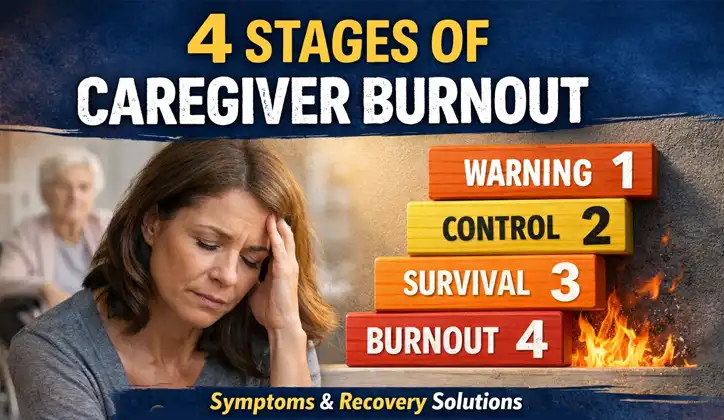
Burnout does not arrive fully formed. It builds in stages each one quieter and more insidious than it appears from the outside. Here is the map.
| Stage | Key Characteristics | Action |
| 1. Warning Stage | You’re managing, but the cracks are forming. Mild stress, irritability, and disrupted sleep. You’re still functioning but something feels off. | Mild · Reversible |
| 2. Control Stage | You begin to withdraw. “No one else can do this properly.” Social isolation deepens. Compassion fatigue silently drains your emotional stamina. | Moderate · Needs Attention |
| 3. Survival Stage | You are just getting through each day. Your own health is no longer a priority. Depression is common here. This is where most caregivers first seek help. | Seek professional help. |
| 4. Burnout Stage | Your body and mind have reached their limit. This is a medical emergency. Immediate intervention and temporary transfer of care responsibilities is necessary. | Crisis · Act Now |
Detailed Analysis of Each Caregiver Burnout Stage
Burnout doesn’t happen overnight; it’s a slow process that consumes your life without you even realizing it. Below, we’ve broken down the psychological and physical aspects of each stage, so you can pinpoint where you’re at.
Stage 1: The Warning Stage
You think you have it under control. You don’t realise yet that you’re already at the edge.
Stage 1 is the hardest to catch because everything still looks fine on the outside. You’re keeping up with caregiving responsibilities. You’re showing up at work. The person you care for is safe and attended to. But internally, something is shifting.
You wake up already tired not the kind of tiredness that sleep fixes, but a low-level flatness that follows you through the day. You find yourself snapping at small things: a misplaced item, a slow driver, a question that seems obvious. And when you make a small mistake in your caregiving missed medication, a late appointment, a moment of impatience the guilt is disproportionately heavy.
This guilt-irritability-guilt cycle is one of the earliest and most reliable indicators of Stage 1 burnout. The caregiver’s internal resources are being quietly depleted, but there is no obvious crisis to point to, so the symptoms are easily rationalised away: “I’m just tired. Everyone is tired. I’ll be fine.”
“In Stage 1, caregivers typically score in the mild-to-moderate range on the Zarit Burden Interview they recognise some burden but believe it is manageable. The risk is that without intervention, this stage reliably escalates.”
| Physical Symptoms | Emotional Symptoms |
|
|
Stage 2: Control Stage
No one else can do this the way I do.” The belief that you are irreplaceable begins to isolate you.
In Stage 2, a psychological shift takes hold that feels, from the inside, like dedication but is actually a symptom. The internal narrative becomes: “No one else understands what my mother needs. No one else will do it right. If I step away, something will go wrong.”
This over-controlling mindset is not a character flaw. It is a stress response a way of maintaining a sense of agency when so much else feels out of control. But it has a predictable consequence: social isolation. Friends’ invitations get declined. Family help is quietly refused. The caregiver becomes the only person in the care equation, and the caregiving identity slowly absorbs everything else.
This is also the stage where compassion fatigue typically begins. Compassion fatigue is distinct from general exhaustion it is the specific erosion of your emotional capacity to empathise. You may notice that you feel less moved by your loved one’s suffering than you once did. You may feel oddly numb or detached during moments that would previously have touched you. This is not coldness. It is depletion. And the shame and guilt that often follow this numbness can accelerate burnout significantly.
| Physical Symptoms | Emotional Symptoms |
|
|
- Challenge the “only I can do this” belief directly. Write down the specific tasks you do. For each one, identify one person who could be trained to do it imperfectly, but adequately. Imperfect help is not the same as no help.
- Attend a caregiver support group. The experience of hearing other caregivers describe your exact thoughts, in your exact words, is clinically significant. The Family Caregiver Alliance maintains a database of US support groups, including virtual options.
- Consider the Zarit Burden Interview (ZBI). This 12-question validated assessment, available through your doctor or the Family Caregiver Alliance, gives you a clinical baseline for your current burden level and is often the first step toward accessing formal respite services.
- Name the compassion fatigue. If you are experiencing emotional numbness toward your loved one, telling a trusted person or therapist rather than internalising the shame is protective. This is a common, documented response to sustained caregiving, not evidence that you are a bad caregiver.
Stage 3: Survival Stage
You are no longer living. You are just getting through each day. You have completely deprioritised your own health.
Stage 3 is where the body sends unmistakable signals that something is seriously wrong and where most caregivers first seek outside help. You have stopped functioning as a full person. You get through the caregiving tasks because you have to, but joy, engagement, and forward-looking thought have largely disappeared.
Many caregivers in Stage 3 describe feeling as though they are watching their life from behind glass going through the motions but disconnected from their own experience. Crying that comes without obvious cause. A profound inability to imagine the future. The overwhelming sense of endless, permanent pressure.
It is important to understand that Stage 3 burnout and clinical depression can co-exist and reinforce each other. They are not the same condition burnout is primarily caused by external overload, while depression is a clinical disorder but chronic burnout is a significant predictor of depressive episodes. If you are experiencing persistent hopelessness, inability to function, or thoughts of self-harm, please discuss this with a doctor or mental health professional immediately.
| Physical Symptoms | Emotional Symptoms |
|
|
Stage 3 is beyond what routine self-care can address. The following are not optional suggestions they are evidence-based necessities.
- See your primary care physician. Describe your symptoms honestly. Many caregivers minimise their own distress when describing it to a doctor. Bring this article if it helps. Request a depression screening and discuss referral options for mental health support.
- Access emergency respite care. Contact your local Area Agency on Aging (use the Eldercare Locator at eldercare.acl.gov) to identify emergency respite programs. Just a couple weeks of respite care can halt worsening burnout.
- Cognitive Behavioural Therapy (CBT) has strong evidence for caregiver burnout intervention, specifically for addressing the thought patterns catastrophising, guilt cycles, perfectionism that sustain Stage 3 burnout. Many therapists now offer telehealth sessions, removing one significant barrier to access.
- Tell a family member or trusted friend the truth. Not a softened version. Stage 3 burnout is a family health emergency, and the people around you need to understand that if they are to help effectively.
Stage 4: The Burnout Crisis
You have pushed past your absolute physical and psychological breaking point. Treat this as a vital health crisis requiring immediate attention.
If you are experiencing thoughts of suicide or self-harm, please stop and contact one of these resources immediately:
📞 988 Suicide & Crisis Lifeline call or text 988 (US, free, confidential, 24/7)
💬 Crisis Text Line text HOME to 741741
🚨 Emergency services call 911 if you or your loved one is in immediate danger
Reaching this stage does not make you a failed caregiver. It makes you a human being who was given an impossible weight without enough support. Getting help now is the only path back to being able to care for anyone including yourself.
Stage 4 is not a personal failure. It is the predictable physiological and psychological outcome of months or years of sustained high-stress caregiving without adequate support. At this stage, the body’s stress-response systems the HPA axis, the autonomic nervous system, the immune system have been operating in near-constant activation for too long. The result is a genuine medical condition, not weakness of character.
Research published in Psychoneuroendocrinology has demonstrated that chronic caregiver stress is associated with measurably accelerated cellular ageing (shortened telomeres), elevated inflammatory markers, and significantly suppressed immune function. The body, at Stage 4, is not recovering between stressors. It is simply accumulating damage.
| Physical Symptoms | Emotional Symptoms |
|
|
Continuing to provide solo care at Stage 4 is not possible or safe for you or for your loved one. These steps are not optional.
- Immediately transfer caregiving responsibilities. Contact a family member, care facility, or agency today. Even a temporary transition of 2–4 weeks can break the crisis cycle. This is not giving up it is the only responsible action available.
- Go to your doctor today or to an emergency room. Describe what is happening with full honesty, including any suicidal thoughts. Request an emergency psychiatric referral if needed. Bring someone you trust if possible.
- Contact the Eldercare Locator (1-800-677-1116) for emergency respite care options in your area.
- Do not manage this alone. Stage 4 requires coordinated support medical, psychological, and practical. No one should navigate this stage without a team.
Spouse Caregiver Burnout: The Weight of Losing a Partner While They’re Still Here
Caregiving for a spouse carries a dimension of grief that other caregiving relationships do not. You are not only managing medical needs you are simultaneously mourning the loss of the person who was your partner, companion, and peer. The relationship has fundamentally changed, and the life you planned together is no longer the life you are living. This form of grief, for a person who is still physically present, is called ambiguous loss, a concept developed by family therapist Pauline Boss.
Spouse caregivers face several additional stressors that compound burnout risk:
- Identity collapse. Your sense of self was partly constructed in relation to your partner as an equal. The shift to caregiver-and-care-recipient changes that fundamental dynamic in ways that can feel disorienting and deeply isolating.
- Intimacy loss. Physical and emotional intimacy typically diminish significantly in caregiving partnerships. The grief associated with this loss is real, legitimate, and rarely discussed in caregiving literature.
- Loneliness in the presence of another person. Many spouse caregivers describe being profoundly lonely while physically never being alone because the person present is no longer the person they knew.
- Anticipatory grief. For degenerative conditions, spouse caregivers often begin grieving before any physical loss has occurred. This prolonged grief is exhausting in ways that are distinct from sudden loss.
If you are a spouse caregiver experiencing these feelings, they are not signs of a failing relationship they are the natural human response to an extraordinarily difficult situation.
The 3 R’s of Caregiver Burnout Recovery
Recovery from caregiver burnout is not a single event it is a process that requires attention to multiple dimensions simultaneously. The following framework, grounded in occupational health research and caregiver-specific clinical practice, provides a practical structure.
R Recognise | R Reduce the Load | R Rebuild |
| Use validated tools. The Zarit Burden Interview (ZBI-12) is the clinical standard for measuring caregiver burden a 12-question assessment your doctor can administer, or that you can access through the Family Caregiver Alliance. Naming your stage honestly is the prerequisite to every other step. | The evidence is unambiguous: solo caregiving without regular breaks reliably produces burnout. A 2022 meta-analysis in The Gerontologist found that structured respite care reduced caregiver depression scores by an average of 21% over 90 days. Reducing load is not a luxury it is a clinical intervention. | Recovery requires actively rebuilding the physical, social, and emotional infrastructure that burnout erodes. This means: consistent sleep (7–9 hours as a non-negotiable target), at minimum one meaningful social connection per week, physical activity, and working with a therapist trained in caregiver-specific issues. |
Recovery Timelines by Stage
| Stage at Entry | Typical Recovery Timeline | Primary Intervention |
|---|---|---|
| Stage 1 | 4–8 weeks | Scheduled respite, routine adjustments, social reconnection |
| Stage 2 | 6–16 weeks | Support groups, delegation, compassion fatigue counselling |
| Stage 3 | 3–6 months | Formal mental health support (CBT), emergency respite, medical evaluation |
| Stage 4 | 6–18 months | Immediate care transfer, psychiatric support, sustained recovery program |
“You cannot pour from an empty vessel. This is not a cliché it is a statement about the neurobiological reality of what sustained stress does to the human brain. Recovery is not indulgence. It is the precondition for continued care.”
The Solution to Get Your Lost Life Back
Do you feel like you can’t go on? Thousands of our users have experienced that it is impossible to break out of this cycle without the right guidelines.
Our USA Caregiver Experts have designed this solution with your current mental state in mind. This is not general advice, it is a complete recovery system.
- Personal checklist: Which will help you achieve small daily goals.
- Expert Support: Guidelines created directly by experts that will reduce your stress levels.
- Resilience Building: Special techniques to avoid burnout in the future.
Don’t delay, start your recovery today: Get Your Caregiver Burnout Recovery Toolkit
Conclusion
Caregiving is not about sacrificing your own life, but rather about serving others while you are healthy. Remember, it is impossible to serve your loved ones if you are not healthy yourself.
Do you feel like you are suffering from burnout? Let us know by contact us for a free consultation. We are here for you.
FAQs about the 4 Stages of Caregiver Burnout
What are the 4 stages of caregiver burnout?
The four stages are: (1) Warning Stage mild stress and irritability; (2) Control Stage social isolation and compassion fatigue onset; (3) Survival Stage emotional exhaustion and depression; (4) Crisis Stage complete breakdown requiring immediate professional intervention.
What is the difference between caregiver burnout and caregiver fatigue?
Caregiver fatigue is temporary tiredness relieved by rest. Caregiver burnout is chronic emotional, physical, and mental exhaustion that rest alone cannot fix it requires systemic changes to caregiving load and professional support
Is there any specific medicine for burnout?
In some cases, healthcare providers may prescribe medication to manage symptoms of anxiety or depression. However, clinical studies show that long-term recovery requires a combination of lifestyle adjustments and professional support. Following a structured caregiver burnout recovery plan is often the most effective way to address the root causes of stress and build lasting resilience.
How long does it take to recover from burnout?
Recovery typically takes 3–12 months depending on severity. Stage 1–2 recovery with proper self-care routines takes 4–12 weeks. Stage 3–4 recovery with professional support takes 3–6 months minimum.
Tena Scallan is a certified caregiving consultant with over a decade of experience supporting family caregivers across the United States. Her work focuses on caregiver mental health, burnout prevention, and building sustainable care systems for families navigating elder care, dementia caregiving, and chronic illness. She founded The Ultimate Caregiving Expert to provide evidence-based, compassionately delivered guidance to caregivers who need it most.