
Caregiver Blog
Ultimate Guide to Patient Transfer Techniques Expert Caregiving Advice [2026]

Caring for a loved one is both an honor and a responsibility. But one of the most physically demanding and highest-risk tasks you will face as a caregiver is moving a patient safely from one surface to another. Every year, thousands of caregivers suffer serious back injuries and thousands of patients experience preventable falls, hip fractures, and skin tears because of unsafe transfer practices. According to the Occupational Safety and Health Administration (OSHA), musculoskeletal injuries from patient handling are among the most common and costly workplace injuries in healthcare.
The good news: safe patient transfer techniques are learnable skills. With the right preparation, proper body mechanics, and appropriate equipment, you can protect yourself and the people in your care. In this guide, I’ll walk you through everything you need: a pre-transfer assessment checklist, the three core techniques every caregiver must know, body mechanics fundamentals, when to use equipment, and what to do in a fall emergency.
Knowing the correct transfer technique is important. But understanding which technique is best for your specific situation requires professional guidance. Our expert caregiver consultants can assess your situation and make the right recommendations.
Pre-Transfer Assessment Do This Before Every Single Transfer
Many accidents happen not because of poor technique, but because of inadequate assessment. Before you move a patient, run through this checklist mentally or on paper.
Assess the Patient
- Mental state: Is the patient alert and cooperative? An anxious, confused, or resistant patient dramatically increases fall risk. If the patient is agitated, postpone the transfer and consult a clinician.
- Weight-bearing ability: Can the patient support at least 50% of their own body weight? This is your threshold for deciding whether a one-person or two-person transfer (or mechanical lift) is needed.
- Pain or injury: Has anything changed since the last transfer? New pain, medication changes, or recent falls change your approach.
- Strength on each side: Patients often have a stronger side always transfer toward the patient’s stronger side when possible.
Assess the Environment
- Clear the path completely no rugs, cords, or obstacles between bed and destination
- Ensure adequate lighting
- Position the wheelchair or destination chair at a 45-degree angle to the bed this minimizes transfer distance
- Lock all brakes on the wheelchair, bed, and any other wheeled equipment
- Adjust bed height to be level with or slightly higher than the wheelchair seat
- Have the gait belt, transfer board, or other aids within arm’s reach before you begin
Proper Footwear
Always have the patient wear non-slip shoes or grip socks. Never transfer a patient barefoot, in socks without grip, or in loose slippers. This single precaution prevents a significant proportion of transfer-related falls.
4 Golden Rules for Safe Patient Transfer
Major accidents during transfers often result from inadequate preparation, which can be frightening for both caregivers and patients. If the environment is not safe, even the best techniques cannot prevent injuries. By following these 4 rules, you can prevent any danger before it occurs:

- Understand the patient’s mental state: Before transferring, tell the patient what you are going to do. If the patient is scared or restless, transferring can be dangerous.
- Wheelchair or equipment positioning: Position the wheelchair at a 45-degree angle to the bed. This reduces the transfer distance.
- Check the brakes (Non-negotiable): Double-check that the brakes on your wheelchair or hospital bed are engaged. A slight movement can cause a major accident.
- Proper attire: Always wear non-slip shoes or grippy socks for the patient. Transferring barefoot or wearing slippers is strictly prohibited.
3 Essential Safe Transfer Techniques Every Caregiver Should Know
Professional caregivers always rely on certain techniques that keep the body free from excessive stress. If you can master these three techniques, you will no longer have to worry about back pain or strain while moving a patient.
Technique 1: Pivot Transfer Bed to Wheelchair (Best for Weight-Bearing Patients)
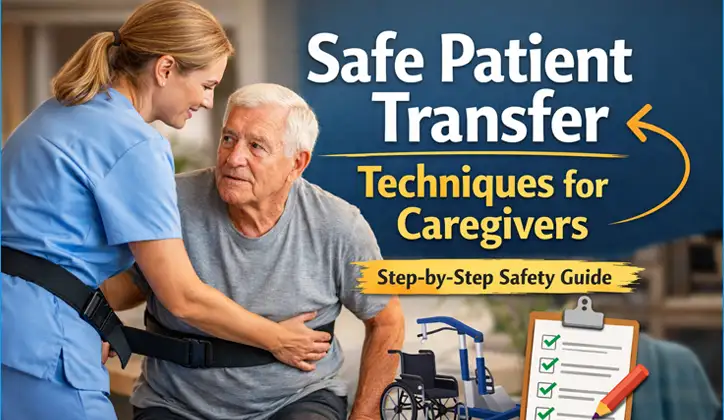
The pivot transfer is the most commonly used technique for patients who can bear some of their own weight. Rather than lifting the patient, you guide them to rotate on their own axis.
Who it’s for: Patients who can stand briefly and bear at least partial weight.
What you need: A gait belt, non-slip footwear, a wheelchair positioned at 45 degrees to the bed.
Step-by-step:
- Sit the patient on the edge of the bed. Both feet should be flat on the floor. Allow a moment for any dizziness to pass before proceeding standing quickly can cause orthostatic hypotension (a sudden drop in blood pressure).
- Apply the gait belt correctly. Wrap it snugly around the patient’s waist, over their clothing (never against bare skin). The buckle should face outward and to the side. You should be able to slide two fingers underneath snug, not tight.
- Position yourself. Stand directly in front of the patient with your feet shoulder-width apart. Place one foot slightly forward for stability. Bring your knee close to the patient’s knee on their weaker side this knee-to-knee contact prevents their knee from buckling outward.
- Instruct and count. Tell the patient: “Place your hands on the bed beside you. On three, push down and stand up don’t grab my neck or shoulders.” Count clearly: “One, two, three stand.” Use a gentle rocking motion to build momentum before the lift.
- Hold the gait belt firmly with an underhand grip on both sides of the belt. Use your legs not your back to assist the rise. Keep the patient’s body close to yours.
- Pivot, don’t twist. Once standing, take small controlled steps to rotate the patient so their back faces the wheelchair. Do not twist your spine. Ask the patient to reach back and feel for the armrest.
- Lower them slowly. Instruct the patient to bend their knees as they sit. Lower them in a controlled movement using your legs, keeping your back straight. Do not let them drop.
- Remove the gait belt once seated and confirm the patient is comfortable and properly positioned.
Common mistake to avoid: Never allow the patient to grab your neck or shoulders. This creates a dangerous pulling force on your cervical spine and can cause you to lose balance. Direct their hands to the bed surface or wheelchair armrests instead.

Technique 2: Sit-to-Stand Transfer Safely Helping a Patient Rise
Patients often lose their balance at the moment of standing, creating a sudden heavy load on the caregiver. This technique works with the body’s natural center of gravity rather than against it.
Who it’s for: Patients who can stand with assistance but need support when rising from a chair, toilet, or the edge of the bed.
Step-by-step:
- Position the patient at the front edge of the chair. Sliding forward moves their center of gravity over their feet, which is essential for safe standing.
- Use the nose over toes cue. Ask the patient to lean forward so their nose is roughly in line with their toes. This position naturally shifts body weight forward, making it mechanically easier to rise. It reduces the load on you significantly.
- Instruct the patient to push from the armrests. They should push up using the chair arms not pull on you. Their arms provide an important assistive force, reducing how much you need to lift.
- Apply the gait belt and guide don’t pull. Hold the gait belt from the side, using your legs to support the transition. You are guiding and stabilizing, not hoisting.
- Allow a standing pause. Once upright, pause for 3–5 seconds before moving. This gives the patient’s blood pressure time to stabilize and allows you both to confirm balance is stable.
For a detailed breakdown of this technique including seated-to-toilet transfers and modified approaches for patients with hip replacements, see our guide on proper caregiver body mechanics.
Technique 3: Lateral Transfer Moving Bedridden Patients
When a patient is completely unable to stand or is bedridden, manual lifting is both dangerous and unnecessary. The lateral transfer using a draw sheet allows you to slide a patient horizontally with minimal friction and virtually no lifting.
Who it’s for: Patients who are fully bedridden, post-surgical patients, or patients recovering from strokes or severe injuries.
This technique requires two caregivers. A single caregiver attempting a lateral transfer alone risks serious back injury and patient harm.
What you need: A sturdy draw sheet or slide sheet positioned under the patient from shoulders to hips.
Step-by-step:
- Position both caregivers. One caregiver stands at the destination surface side, the other at the current surface side. Both hold the draw sheet firmly with a wide grip.
- Lower both bed surfaces to the same height. Eliminate any height difference between the surfaces before beginning.
- On a shared count of “1-2-3,” the caregiver at the destination side pulls the sheet while the caregiver at the origin side provides a controlled assist. Movement should be smooth, horizontal, and in a single coordinated motion.
- Roll the sheet as you get closer to the destination to maintain tension and control.
- Reposition the patient once transferred ensure proper alignment, pressure relief positioning, and comfort.
Why a draw sheet works: It dramatically reduces the friction between the patient’s skin and the mattress surface, protecting fragile elderly skin from tears while also protecting the caregiver’s lumbar spine. Never drag a patient directly on a sheet without a slide sheet direct friction causes skin damage.
For patients requiring frequent lateral repositioning (every 2 hours for pressure ulcer prevention), ask an occupational therapist about purpose-made slide sheets and repositioning aids. See our guide on essential ambulation assistive devices for equipment comparisons.
Professional Body Mechanics: How to Protect Your Back on Every Transfer
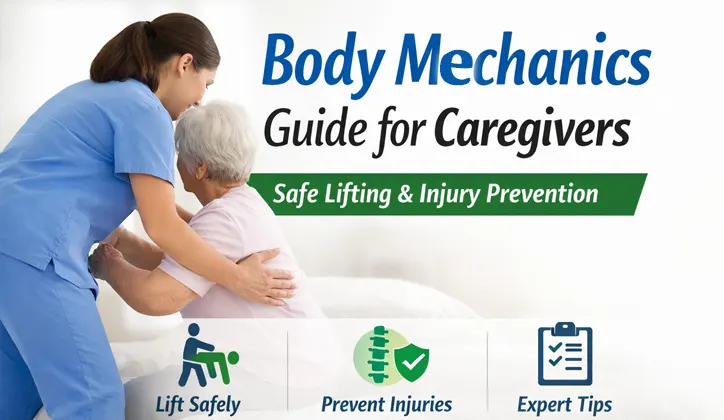
Caregiver back injuries are career-ending and life-limiting. The leading cause is not heavy patients it is poor body mechanics during routine tasks. Internalize these principles until they become automatic.
Foot position: Stand with feet shoulder-width apart, one foot slightly ahead of the other. This “staggered stance” gives you a stable base of support and allows weight transfer without twisting.
Bend at the knees, not the waist: This cannot be overstated. Bending forward at the waist to lift or to adjust a patient’s legs in bed is one of the most dangerous movements in caregiving. Squat or lunge; never hinge at the lower back.
Keep the load close: The further a patient’s body is from yours during a transfer, the greater the mechanical leverage on your spine. Keep them as close as possible throughout the movement.
Never twist while bearing load: Pivot your whole body using your feet. Twisting the spine under load is how disc injuries happen. Always step to turn.
Use your legs as the engine: Your quadriceps and gluteal muscles are far stronger than your back muscles. Drive all lifts and assists from your legs.
Exhale on exertion: Breathing out during the effort phase of a transfer (the standing moment, the pivot) helps stabilize your core and reduces intra-abdominal pressure on your spine.
For a comprehensive reference on posture and movement patterns in caregiving, see our dedicated guide on proper caregiver body mechanics.
Two-Person Transfer Technique
Some transfers are simply not safe for one person. If any of the following applies, use a two-person transfer:
- The patient weighs over 200 lbs and has limited weight-bearing ability
- The patient is unpredictable, combative, or has dementia
- You are performing a lateral transfer
- The patient has active IV lines, catheter tubes, or other medical attachments that need management during movement
How a two-person pivot transfer works:
- Caregiver 1 (primary) stands directly in front of the patient and holds the gait belt, leads the count, and manages the pivot
- Caregiver 2 (secondary) stands to one side and manages the patient’s hips and legs, ensuring the knees don’t buckle and supporting the rotation
Communication between caregivers is critical. One person calls the count. Both move simultaneously. Decide in advance who leads and what signal to use.
When to Use Transfer Equipment
Manual transfer has limits. These are the clear indicators that equipment is needed:
| Situation | Recommended Equipment |
|---|---|
| Patient cannot support any weight | Hoyer lift (full-body sling) |
| Patient can bear some weight, needs grip support | Gait belt |
| Transfer between two same-height surfaces (bed to stretcher) | Slide board or lateral air-transfer device |
| Very heavy or bariatric patient | Bariatric Hoyer lift (rated for patient’s weight) |
| Repeated daily repositioning in bed | Slide sheet system |
The 50% rule: If a patient cannot independently support at least 50% of their own body weight through their legs, do not attempt a stand-pivot transfer without a mechanical assist device. This threshold exists because the physical load on the caregiver exceeds safe limits below this point.
For a complete walkthrough of equipment selection and proper technique with mechanical lifts, read our guide on how to safely use a Hoyer lift. For a full comparison of transfer boards, gait belts, and slide sheets, see our Choosing the Right Transfer Equipment overview.
Transfer Risks: What Can Go Wrong and How to Prevent It
| Risk | Prevention |
|---|---|
| Patient fall mid-transfer | Complete pre-transfer assessment; use gait belt; never rush |
| Caregiver lumbar injury | Bend knees not waist; keep load close; use equipment when indicated |
| Skin tear from improper grip | Never grip bare skin; always use a gait belt; use draw sheet for lateral moves |
| Orthostatic hypotension (dizziness on standing) | Pause 3-5 seconds after standing before moving; dangle legs before transfer from bed |
| Patient grabbing caregiver’s neck | Redirect hands to bed surface or armrests; brief the patient before every transfer |
| Equipment failure | Check brakes and belts before every transfer; inspect equipment weekly |
What to Do if a Patient Falls During a Transfer
Do not attempt to catch or stop a falling patient by force this is how both patients and caregivers suffer the most serious injuries. Instead:
- Do not resist the fall. The moment you sense the patient going down, shift to a controlled lowering.
- Guide, don’t catch. Hold the gait belt firmly and guide the patient’s descent by bending your knees and lowering yourself with them.
- Direct them toward the floor not toward furniture. A controlled floor descent is far safer than an uncontrolled collision with a wheelchair armrest or bed frame.
- Protect their head. Guide it away from hard surfaces as the primary priority during descent.
- Do not attempt to lift them from the floor without proper equipment and a second person. Call for help. A patient on the floor is not in immediate danger from staying there for a few minutes.
- Assess for injury before any movement. Check for pain, swelling, or inability to move limbs. If any of these are present, call emergency services.
- Document the fall and report it through your required protocols.
Safe Transfer Do’s and Don’ts Quick Reference
| Topic | Do | Don’t |
|---|---|---|
| Footwear | Have patient wear non-slip shoes or grip socks | Transfer barefoot or in loose slippers |
| Gait belt | Apply snugly over clothing with buckle to the side | Pull on the patient’s underarms, waistband, or clothing |
| Body mechanics | Bend knees; keep load close; pivot with feet | Bend at the waist; twist your spine under load |
| Brakes | Check locks on all wheeled equipment before starting | Assume brakes are locked because “they were last time” |
| Communication | Explain every step; count aloud; move at the patient’s pace | Rush; surprise the patient with sudden movements |
| Weight limits | Know the patient’s weight-bearing status before each transfer | Attempt a standing transfer if patient can’t bear 50% of weight |
| Heavy patients | Use bariatric-rated equipment; involve a second caregiver | Attempt to solo-transfer a patient beyond your physical capacity |
| After the transfer | Remove gait belt; confirm patient comfort; document if required | Leave gait belt on seated patient for extended periods |
Printable Caregiver Transfer Safety Checklist
Download and print our caregiver transfer safety checklist designed for real-world use. Keep it posted in the care area. It covers pre-transfer assessment, technique reminders, equipment checks, and post-transfer steps in a single laminate-ready format.
FAQs about Safe Patient Transfer Techniques
Can I transfer a patient alone?
If the patient cannot support even half of their own weight, it is not safe to transfer alone. In that case, get help from a second person or use a mechanical lift.
Why is the gate belt so important?
The gate belt gives you control over the patient and eliminates the need to pull on the patient’s clothing, which reduces injury to the patient’s skin.
What should I do if the patient keeps falling during the transfer?
Do not try to restrain the patient by force. Instead, hold them close to your body and slowly slide them down towards the floor to avoid hitting their head.
Conclusion
Mastering safe patient transfer techniques is one of the most important clinical skills you can develop as a caregiver. The stakes are high on both sides for the patient, a fall during a transfer can mean a hip fracture and a cascade of health complications; for you, a single moment of poor body mechanics can result in a permanent back injury.
These techniques are universal. But to find the best approach for your care receiver, you need professional caregiver consulting that will assess your specific situation.
If you are caring for a loved one and have never received hands-on transfer training, we strongly recommend seeking guidance from a licensed occupational therapist or physical therapist many home health agencies provide this training at no charge as part of care planning.
Medical Disclaimer: This guide is for informational purposes only and does not replace hands-on clinical training. Always follow your facility’s protocols, consult a licensed occupational therapist or physical therapist before beginning patient transfers, and follow manufacturer instructions for all equipment.