Caregiver Communication Skills Training: Complete Guide to Improving Patient Outcomes

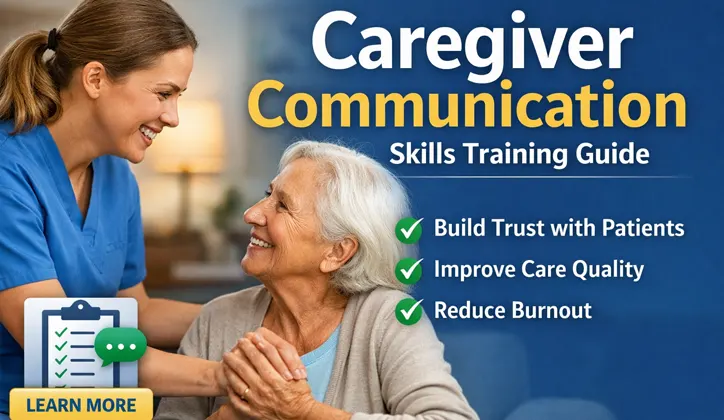
Effective caregiver communication skills training plays a major role in ensuring a patient’s speedy recovery or improving patient outcomes. Knowing the right communication techniques reduces misunderstandings and directly helps reduce caregiver burnout or stress. Basically, active listening, empathy, and the use of appropriate body language are the main strengths of a professional caregiver, which manifoldly increase the quality of service.
In this guide, caregivers will learn how to build trust through effective communication, practice empathy and active listening in real-life situations, and use simple, clear language when supporting individuals with dementia or complex care needs.
What is Caregiver Communication Skills Training?
Caregiver Communication Skills Training is a specialised skill-development process that helps a caregiver communicate effectively and compassionately with the patient, their family, and healthcare professionals. It is not just about speaking, but also about understanding what the patient is not saying and making the right decisions while remaining calm in complex situations.
The three main goals of this training are:
- Active Listening: Listening attentively to the patient’s needs and emotions.
- De-escalation: Calming down heated or complex situations through patience and intelligence.
- Clarity & Confidence: Increasing patient confidence by eliminating ambiguity and providing accurate information.
Why is Communication the Most Important Skill for a Caregiver?
According to the National Alliance for Caregiving (NAC), nearly 60% of caregivers feel that they suffer from excessive stress due to a lack of proper communication.
As an expert, I have seen that stress created by misunderstanding directly leads to Caregiver Burnout. When you cannot understand the language of a patient’s physical pain or the meaning behind the words of a patient with dementia, a kind of helplessness will arise within you. With the right training, you can build a trust-building relationship with the patient, which greatly increases the effectiveness of treatment or Patient Outcomes. This is not only professionalism, but it is also a human form of service.
The 7 Main Pillars of Communication in Healthcare
There are certain standards of communication in medical science that, if followed, leave no room for misunderstandings. By adhering to these pillars, you will be able to communicate the right information even in difficult situations.
1. Clarity
Avoid medical terms or complex words. Keep what you tell the patient simple and unambiguous. For example, instead of saying, Your pulse rate is now normal, say, Your heart is working very well now.
2. Concise
Talking too much can confuse the patient. Speak in short sentences, especially for those with dementia or aging problems. Give only one instruction at a time.
3. Concrete
Don’t give vague assurances. Instead of saying, “You’ll get better soon,” say, “Your therapy today will help you build strength in your legs.” This builds trust in the patient.
4. Correctness
Don’t make mistakes with medical information. If you are unsure about something, take your time politely. Incorrect information can be life-threatening for the patient.
5. Consistency
Your body language and your facial expressions should be consistent. The patient feels insulted when you say “I’m listening”, but look at your watch.
6. Complete
Give complete information when giving information. When telling the patient the time of the medication, briefly explain why they should take it and what the possible side effects may be.
7. Courteous
Call the patient by their preferred name. Ask permission before speaking. Protecting the patient’s privacy is part of your professionalism.
5 C’s vs. 7 C’s: Healthcare Context
Many people are confused about whether to follow the 5 or 7 ‘C’s. The table below clarifies this:
| Features | 5 C’s (Basic) | 7 C’s (full) |
| Circumference | For initial contact | For professional and flawless service |
| Ingredients | Clear, Concise, Courteous, Correct, Complete | Previous 5 + Concrete, Coherent |
| Usage | Everyday common words | In complex medical reports or case studies |
Active Listening: An Art Deeper Than Hearing
Listening is more important than speaking when it comes to providing care. When a patient feels that they are being listened to, half of their emotional pain is gone.
5 steps of active listening:
- Attending: Put away the TV or phone. Sit facing the patient.
- Refraining from Interruption: Let the patient finish speaking. Do not interrupt.
- Paraphrasing: Rephrase what the patient said in your own words. For example: What do you mean you’re feeling dizzy today?
- Validating Emotions: I understand why you are suffering. This is a really difficult time. This one sentence reduces the patient’s grief by half.
- Clarifying: Ask open-ended questions those that cannot be answered with just yes or no to clarify unclear points.
In my Caregiver Communication Skills Workbook, I have included 25 special worksheets to enhance listening skills that will help you become a ‘master listener’.
Special Cases: Communication with Dementia and Autism Patients
For patients with special needs, the grammar of communication changes completely. They require endless patience and strategies that will reassure them without arousing them.
A. Strategies for patients with dementia or Alzheimer’s:
- Validation Therapy: If they say something wrong, don’t argue with them. Understand their emotions. Your mother was a very good person, wasn’t she? Talk to her like this.
- Attention: Before speaking, stand in front of the patient and make your presence known by gently touching him.
- Simplification: Ask them directly, “Shall we have tea now?” so that they can answer more easily.
B. For autism or developmental disorders:
- Visual Communication: Many times, pictures or gestures work better than words.
- Predictability: Let them know before you do anything. They may panic if you start something suddenly.
- Sensory check: Make sure the environment is quiet while you are talking. Noise or bright lights can distract them.
Non-verbal Communication: What Your Body is Saying
Our gestures convey a much more powerful message than what we say with our mouths. A skilled caregiver must always maintain control over their body language.
- Body Language: Don’t stand with your arms crossed (this sends a negative signal). Keep your arms at your sides and lean forward slightly when speaking.
- Tone of Voice: Always speak in a calm and low voice. Speaking loudly means you are losing control, which can make the patient anxious.
- The Power of Touch: Placing your hand on the patient’s shoulder or hand at the right time increases their trust in you. However, be sure of the patient’s preference before touching.
Self-Advocacy and Professional Communication for Caregivers
A caregiver has to coordinate with the medical team on a regular basis. If information is not shared properly, there is a possibility of major errors in care.
- Talking to doctors: Write down all the information in bullet points. Follow the “SBAR” method (Situation, Background, Assessment, Recommendation).
- Bridging the distance with family: Give family members all updates, but maintain confidentiality. Show empathy if they need emotional support.
Why is this Caregiver Communication Skills Workbook your Next Best Investment?
Learning doesn’t last unless you put it into practice. This workbook is designed so that you can learn from your mistakes every day and constantly improve yourself.
- Routine Practice: Spend 5 minutes every day writing your communication reflection.
- Role Play Exercise: There are scripts given for what to say in challenging situations.
- Stress Management Tools: Strategies for controlling your own anger or pride.
- Guidelines in simple Bengali: Language is not a barrier here. Everything is explained in a very simple way.
If you love your profession and want to establish yourself as a ‘highly paid’ or skilled caregiver, there is no easier way than to improve your communication skills.
Want to transform your career. Get our Caregiver Communication Skills Workbook now
FAQs – about Caregiver Communication Skills Training
Question 1: What should I do if the patient becomes very angry?
Stay quiet and let him talk. Don’t argue back and forth. When his anger has subsided, try to resolve his problem in a gentler tone. There is a detailed chapter on this in our workbook.
Can I have a personal story with the patient?
Sharing a little can deepen the relationship, but it is important to keep the focus on the patient. It is important to maintain professional boundaries.
How do I communicate if there is a language barrier or language problem?
Use translator apps, gestures, and pictures. Smiles have always been a universal language that helps build connections.
Conclusion
The caregiving profession is a blessing from God. You are standing by someone’s side during their most difficult time. Make this time more beautiful by using it. Before being a good caregiver, you need to be a good person, and that humanity shines through in your words and actions.
Decide to upgrade your skills today. Transform yourself from an ordinary to an extraordinary caregiver.