
7 Dangerous Hoyer Lift Mistakes That Cause Injuries And How to Prevent Them

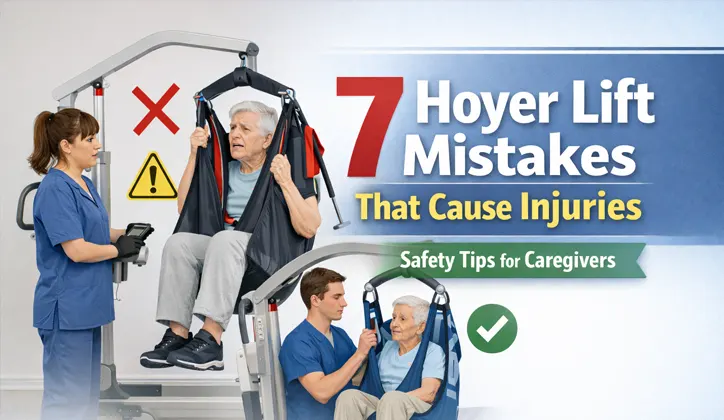
It is a privilege to care for a loved one or an elderly person. But when it comes to using a Hoyer Lift or patient lift for their mobility, safety comes first. Even a small mistake can lead to a major accident.
As a caregiving expert, I have seen that many times, both the patient and the caregiver get injured while using a lift due to lack of proper training. In today’s blog, I will talk about 7 common Hoyer Lift mistakes that you need to know today.
7 Common Mistakes to Avoid
I’m Tena Scallan, and in my 25+ years of real-world caregiving experience, I’ve seen that many times, both patients and caregivers get injured while using lifts due to lack of proper training. Below are 7 mistakes to avoid:
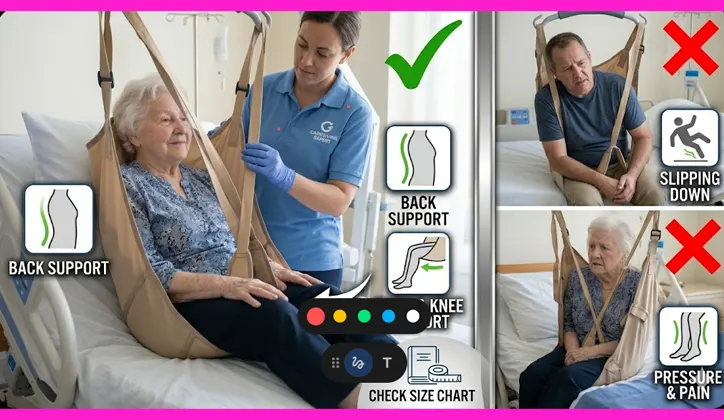
1. Using the wrong size sling
Many people think that one size sling can lift everyone. But this is the biggest mistake. If the sling is too big, the patient may fall down; and if it is too small, it may cause severe pressure or pain on the body.
- Solution: Choose the correct sling size based on the patient’s weight and height. Before lifting, check whether the sling is too loose or too tight.
- Expert Tip: Always follow the size chart provided by the manufacturer. Keep in mind that sizes may vary slightly depending on the manual Hoyer Lift or electric lift brand.
2. Not keeping the base legs of the lift wide
It is very dangerous to lift a patient with the two legs, or Base Legs, at the bottom of the patient lift in a narrow position. This can cause the lift to tilt to one side and overturn.
- Solution: Spread the base legs of the lift as wide as possible just before lifting the patient. This keeps the lift stable.
For details on proper elevator usage, please contact us. Read the guide about how to use a Hoyer lift in senior care.
3. Lifting the patient too high
Many caregivers think that lifting a patient higher may make it easier to move them from one place to another. In fact, the higher you lift the patient, the more difficult it becomes to balance the lift.
- Solution: Lift the patient just a few inches off the bed or chair so they can clear surfaces. This will reduce the patient’s fear and give you more control.
4. Not following proper body mechanics
The main purpose of using the Hoyer Lift is to reduce your pain. But many times, caregivers use their back strength (instead of their body) when pulling the lift or positioning the patient. This can lead to long-term back pain.
- Solution: Always use your leg muscles and keep your back straight. Use your body weight to pull the lift, not push it.
To avoid injury, follow our Caregiver Body Mechanics Guide.
5. Not checking hooks/clips
Starting a lift without checking that the sling straps are properly attached to the lift bar is a major risk. Sometimes a strap can come loose and seriously injure the patient.
- The Tug Test: Give the straps a gentle tug before lifting the patient completely. Make sure the hooks are locked in place.
- Solution: Double-Check before lifting the patient completely. Are the straps tightened evenly? Are any of them loose?
6. Riding the elevator up and down or on carpet
The Hoyer Lift is designed for use on flat surfaces. Not only is it difficult to pull the lift across carpet, but it can also get stuck and jerk, which can be frightening for the patient.
- Solution: Use hard floors if possible or remove carpets. If necessary, move the elevator slowly in small steps.
7. Not talking to the patient (Communication Gap)
Lifting someone with a machine is stressful. If you start lifting the patient suddenly and silently, they may become restless with fear.
- Solution: Talk to the patient at each step. For example, “Now I’m going to lift you a little,” this will help the patient stay mentally prepared and calm.
Do’s vs. Don’ts – Quick Reference Table
| Subject | Do’s | Don’ts |
| Base leg | Always keep it wide open. | Do not lift the patient in a closed position. |
| Sling | Check the color-coded loops. | Do not use a torn sling. |
| Surface | Always hard and flat floors. | Do not pull high or low or on the carpet. |
| Control | Check the battery before use. | Do not start work with a drained battery. |
Bonus: A Safety Checklist for You
To ensure safe transfers, we have created a Hoyer Lift Safety & Training Checklist. You can print it out and keep it with you.
Download the Full Training Checklist
Do you need more help?
Caregiving is a difficult job, but with the right knowledge, you can provide the best care for your loved one. If you would like advice from someone experienced in a specific area, you can accept our Caregiver Consulting Service.
FAQs about Hoyer Lift Mistakes
Is the Hoyer Lift safe to use alone?
It depends on the model. However, it is always better to have two people for safety reasons, especially if the patient is heavy.
How often should the sling be changed?
If you see any tears or threads coming out of the sling, change it immediately. Generally, you should check it thoroughly every 6 months.
Disclaimer: This guide is for informational purposes only. Please seek professional training or advice from a doctor before using any medical equipment.