
Caregiver Blog
Senior Driving Safety Checklist for Caregivers: Practical Guide for Aging Parents

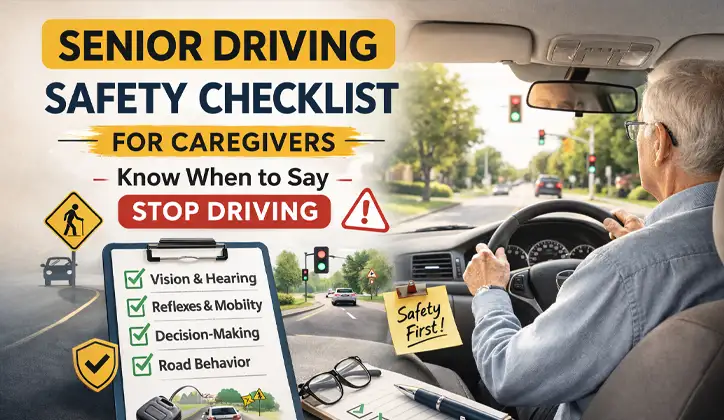
One of our most difficult tasks as caregivers is assessing the ability of our loved ones or elderly parents to drive. Driving is not just a means of getting from one place to another; it is a symbol of their independence and individuality. But as we age, this independence can often become compromised due to physical and mental changes.
In today’s detailed guide, we will discuss how you can ensure your loved one’s safety using a Senior Driving Safety Checklist and when you should advise them to stop driving.
What Is a Senior Driving Safety Checklist?
The Senior Driving Safety Checklist is a structured assessment method that helps caregivers and families monitor the driving skills of older adults. It is based on changes in vision, hearing, reflexes, and cognitive abilities. Its main goal is to identify early signs of declining driving skills and take necessary measures before a major accident occurs.
Key elements of the checklist:
- Physical ability: Neck rotation, pedal control and visual clarity.
- Mental alert: Ability to understand traffic signals and make quick decisions.
- Behavioral changes: Being unnecessarily panicked on the road or repeatedly getting hit by small bumps.
- Environmental awareness: Maintaining the proper distance when changing lanes and parking.
Why does driving safety change with age?
As we age, our bodies and brains undergo changes that directly affect our ability to drive. Studies have shown that older drivers have a reduced reaction time or ability to react quickly.
Main reasons:
- Vision Changes: Cataracts, glaucoma, or macular degeneration can cause difficulty seeing at night and reduce the ability to tolerate glare or bright light
- Cognitive Decline: As we age, our ability to pay attention or divided attention decreases. At the same time, it becomes difficult to follow GPS or traffic signs.
- Medication Side Effects: Elderly people often take blood pressure or sleeping medications, which can cause drowsiness or dizziness. This can seriously impair driving performance.
- Physical inertia: Arthritis or joint pain makes it impossible to quickly brake or turn your neck to see the car behind you.
4 main categories: Elderly driving risk assessment
Assessing driving skills is a complex process. To make your job as a caregiver easier, we’ve broken down driving risks into four main categories, which will help you better understand a senior driver’s capabilities.
Physical Health Warning Signs
For older drivers, physical ability is directly related to vehicle control. Use this checklist to see how joint pain or poor vision is affecting their reflexes.
- Vision and hearing: Can they hear the horn? Can they read the signs on the road far away?
- Mobility: Can you move your foot quickly between the brake and accelerator?
- Neck flexibility: Does the neck rotate enough to check blind spots?
Cognitive and Memory Red Flags
Driving is a highly mental task that requires split-second decisions. If your loved one is struggling to maintain attention or understand familiar instructions, it could be a sign of significant cognitive impairment.
- Getting lost on a familiar path: Do they often forget familiar routes?
- Missing a traffic signal: Not paying attention to red lights or ‘Stop’ signs.
- Slow decision making: Being too hesitant when making turns or at intersections.
Behavioral Driving Warning Signs
The position of the car on the road and minor changes in behavior indicate how safe the driver is. It is very important to observe their confidence and logical responses while driving.
- Lane Drifting: Is the car repeatedly drifting out of the lane?
- Unexplained loss: Are there new scratches or dings appearing on the bumper or side of the car that they don’t have the answer to?
- Aggressive behavior: Even though they were calm before, are they now getting very angry on the road (Road rage)?
Emotional and Psychological Changes
Many times, even when there is no physical barrier, accidents can occur due to emotional instability or fear. Part of a safe assessment is to observe changes in your loved one’s mental state before or after driving.
- Driving Fear: Are they afraid to go on the highway now?
- Unnecessary worry: Is there unrest in them just from hearing about taking out the car?
Green-Yellow-Red Risk Framework: A Guide to Decision Making for Caregivers
It’s not always possible to stop driving abruptly. We can follow a practical framework:
- Green: The driver is safe. However, get an eye exam every 6 months and follow the regular checklist.
- Yellow: There are some risks involved. Limit driving in these conditions. For example, drive only during daylight hours, stay within 5 miles of a known hazard, and avoid driving in rain or fog.
- Red: When they are unable to remember traffic laws or repeatedly have near misses, it is mandatory to stop driving.
Vehicle and Environmental Safety Adjustments
Sometimes, small changes can increase driving time:
- Adaptive Equipment: Adding oversized side mirrors and a backup camera.
- Smart Technology: Use vehicles that have lane departure warning and automatic braking systems.
- Driving conditions: Recommend driving only during the day and when traffic is light.
Ride-Along Assessment: Side-by-Side Observation
Just watching from a distance is not enough. Sometimes, go for a ride with them. Observe:
- Are they fastening their seatbelts correctly?
- Are you giving your turn signals on time?
- Are you maintaining a safe distance (3-second rule) from other vehicles?
- Are they braking too hard or too slowly?
Driving conversation techniques
This is the most emotional part. They may feel insulted if you directly say, “You won’t drive anymore.”
- Show empathy: “I know driving is part of your freedom, but your safety is the biggest thing to me.”
- Don’t blame: Instead of saying, “You’re making a mistake,” say, “I’ve noticed you’re having trouble driving lately.”
- Alternative measures: Have a plan in place for how they will travel (Uber, a driver, or a family member) if they stop driving.
When is a professional assessment necessary?
If they don’t want to listen to you, seek help from a specialist:
- Occupational Therapy Driving Educator: They professionally test driving skills.
- Doctor’s advice: An official letter from a doctor often helps in making a decision.
- DMV Re-evaluation: In some cases, a retest may be requested at the DMV.
Printable Senior Driving Safety Checklist & Workbook
Keeping a systematic record is essential when it comes to caregiving. If you want to track your loved one’s driving skills day after day, a structured workbook will make your job much easier.
Our Driver’s License Workbook is specially designed for caregivers. It includes:
- Daily driving log.
- Detailed safety checklist.
- Medication and a reflex tracker.
This will not only help you make decisions, but you will also have the right data or evidence when talking to the doctor.
FAQs about Safe Driving for Seniors
What are the 5 ‘C’s of safe driving?
The 5 ‘C’s of safe driving are: Care, Caution, Consideration, Common sense, and Courtesy.
What is the 3-second rule?
Maintain a distance of at least 3 seconds from the vehicle in front. For older people, this should be 4 or 5 seconds.
What is the most unsafe driving behavior?
The most dangerous are distracted driving and disobeying traffic signals.
What are safe driving tips for seniors?
Get regular eye exams, drive in daylight, and avoid major junctions or highways.
Conclusion
The decision to stop driving can be difficult, but as a responsible caregiver, safety is your first priority. Using a proper Senior Driving Safety Checklist and our Driver’s License Workbook, you can make the process easy and scientific.
Take steps to ensure the safety of your loved ones today.
Disclaimer: This guide is for informational purposes only. Always consult with a medical professional or a certified driving instructor for official evaluations.