
Caregiver Blog
The Anatomy of a Caregiver: What the Role Really Costs You

The Anatomy of a Caregiver
Understanding the full shape of a role no one trains you for
The anatomy of a caregiver was created because I didn’t become a caregiver in a single moment. I became one at ten years old, and I have not stopped since.
Over the years, I have supported loved ones through addiction, cancer, Alzheimer’s, the loss of a family member to suicide, and the kind of quiet family dysfunction that never shows up on a chart. I have sat in waiting rooms as a child too young to understand what the doctors were saying, and I sit in them today, decades later, still showing up. My caregiving story does not have a single beginning. It has one long, unbroken thread running from where I started to where I am now: actively caregiving, in real time, in my own home.
I am telling you this not because my story is unusual. It is not. It is because it is common, and no one ever built a system for it.
What Caregiving Actually Touches
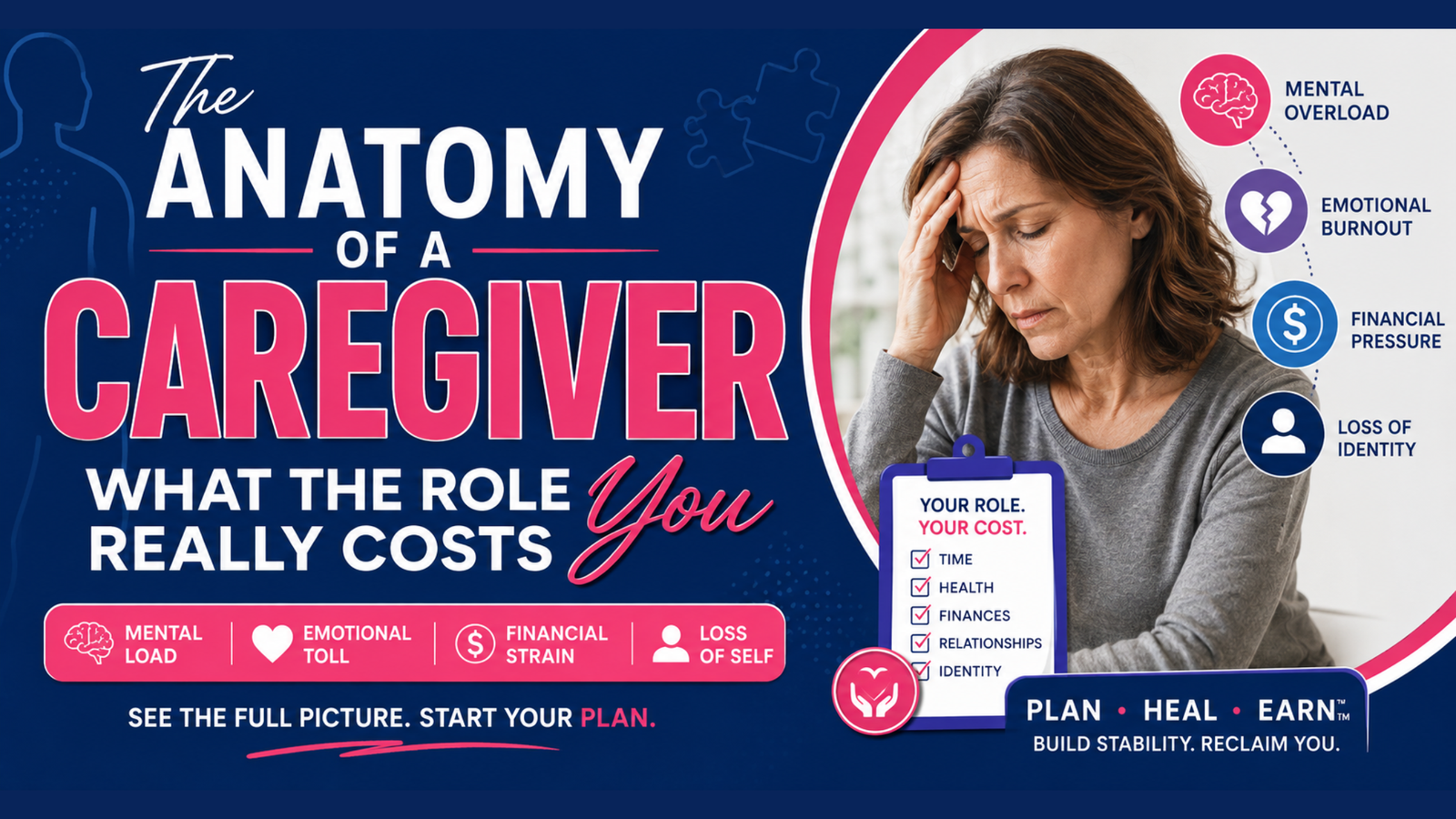
The anatomy of a caregiver in caregiving is often described as one task on a to do list. In reality, it reaches into nearly every part of a person’s life at once. Think of it as an anatomy, a full body, with each part affected by the role in a different way.
- The Body. Physical exhaustion that sleep does not fix, disrupted sleep from monitoring someone through the night, and your own medical care pushed to the bottom of the list until a symptom finally forces you to deal with it.
- The Mind. Constant decision making that never fully turns off, hypervigilance that keeps you scanning for the next problem even in quiet moments, and grief that has nowhere to go because the crisis is still happening and there is no space to feel it yet.
- The Household. Shifting routines as needs change week to week, safety adjustments around the home, medication schedules that have to be tracked exactly, and a growing list of appointments that all depend on you to arrange, remember, and show up for.
- The Relationships. Family roles renegotiated overnight, often without anyone actually agreeing to the new arrangement, growing isolation from friends who cannot fully understand what your days look like now, and boundaries that get tested daily by people who need more than you have to give.
- The Finances. Reduced work hours or a job left behind entirely, income that shrinks right when expenses grow, and costs no one budgeted for: medical equipment, home modifications, missed workdays, and care you end up paying for out of pocket.
- The Identity. The slow erosion of who you were before this role took over, the hobbies and friendships that quietly disappeared, and the strange grief of losing yourself while everyone assumes you are fine because you are still showing up.
The Stages Caregivers Move Through
The anatomy of a caregiver recognizes themselves somewhere in this progression, even if it did not happen in a straight line.
- Sudden Onset. A diagnosis, an accident, or a phone call in the middle of the night that changes everything before you have time to process it. There is no warm-up period, just an immediate shift into managing decisions you never expected to make.
- Slow Realization. Noticing a decline that has actually been happening for a while, the missed medications, the forgotten names, the small accidents you explained away until the pattern became impossible to ignore. This stage often carries its own grief, because you realize you have been adjusting to a new reality for longer than you admitted to yourself.
- Deep Immersion. Caregiving becomes the center of daily life, and everything else, work, relationships, your own health, adjusts around it. Your calendar, your energy, and your decisions all start running through the lens of what the person you care for needs.
- The Long Haul. The role becomes permanent rather than a season you are getting through, largely invisible to everyone outside your home, and quietly exhausting in a way that does not show up in a single dramatic moment but builds year over year.
- Life After. What remains of you and your life once caregiving changes or ends, whether that is through recovery, a shift in care needs, or loss. This stage is rarely talked about, but rebuilding an identity and a life after years in this role is its own difficult transition.
The Numbers Behind the Anatomy of a Caregiver
There are 63 million family caregivers in the United States providing an estimated $648 billion in unpaid labor every year. Despite carrying that weight, most caregivers receive no formal training, no built-in support system, and no plan. The anatomy of a caregiver is about showing you how to get this right.
Caregivers don’t fail. Systems fail them.
Why Plan Heal Earn Exists
The anatomy of a caregiver shows how caregiving affects your organization, your emotional and physical stability, and your income, often all three at the same time. Plan Heal Earn, The Caregiver Stability Operating System, was built as the infrastructure that holds all three pieces together, because no existing system was built to do that.
- PLAN brings structure to the parts of caregiving that feel scattered: the medications, the appointments, the paperwork, and the daily decisions that used to live only in your head. It gives you a system to fall back on instead of reconstructing everything from memory each day.
- HEAL supports the emotional and physical toll caregiving takes on you, the exhaustion, the guilt, the grief that has nowhere to go, and the version of you that gets quietly set aside while you take care of everyone else. It exists because stabilizing you is not optional, it is what makes the rest of this sustainable.
- EARN protects your income and financial stability while you carry this role, whether that means adapting to reduced work hours, recovering ground after time away from a job, or building something new around the schedule caregiving actually leaves you. It recognizes that financial pressure is part of the caregiving burden too, not separate from it.
Where to Start in The Anatomy of a Caregiver
You do not have to figure out everything at once. Start wherever fits your capacity right now.
Free guide, I Am More Than a Caregiver:
The Caregiver Reset, $27:
The Caregiver Stability Snapshot, $197:
The Caregiver Stability Plan, $500:
You are not doing this wrong. You are doing something enormously hard, without a system that was ever built for you. That is what Plan Heal Earn is for.
Conclusion
The anatomy of a caregiver helps you realize that you did not choose this role, and you were never handed a manual for it. Caregiving asks something from every part of you: your body, your mind, your relationships, your finances, and your sense of who you are, often all at once and without warning. If you are exhausted, behind on your own needs, or unsure where to even start untangling everything you are carrying, that is not a personal failure. It is what happens when someone takes on an enormous responsibility with no system built to support them.
That is exactly why Plan Heal Earn exists. You do not have to figure out the structure, the recovery, and the income all on your own, and you do not have to do it all today.