
Caregiver Blog
Caregiver Overwhelm? The Complete PLAN Guide

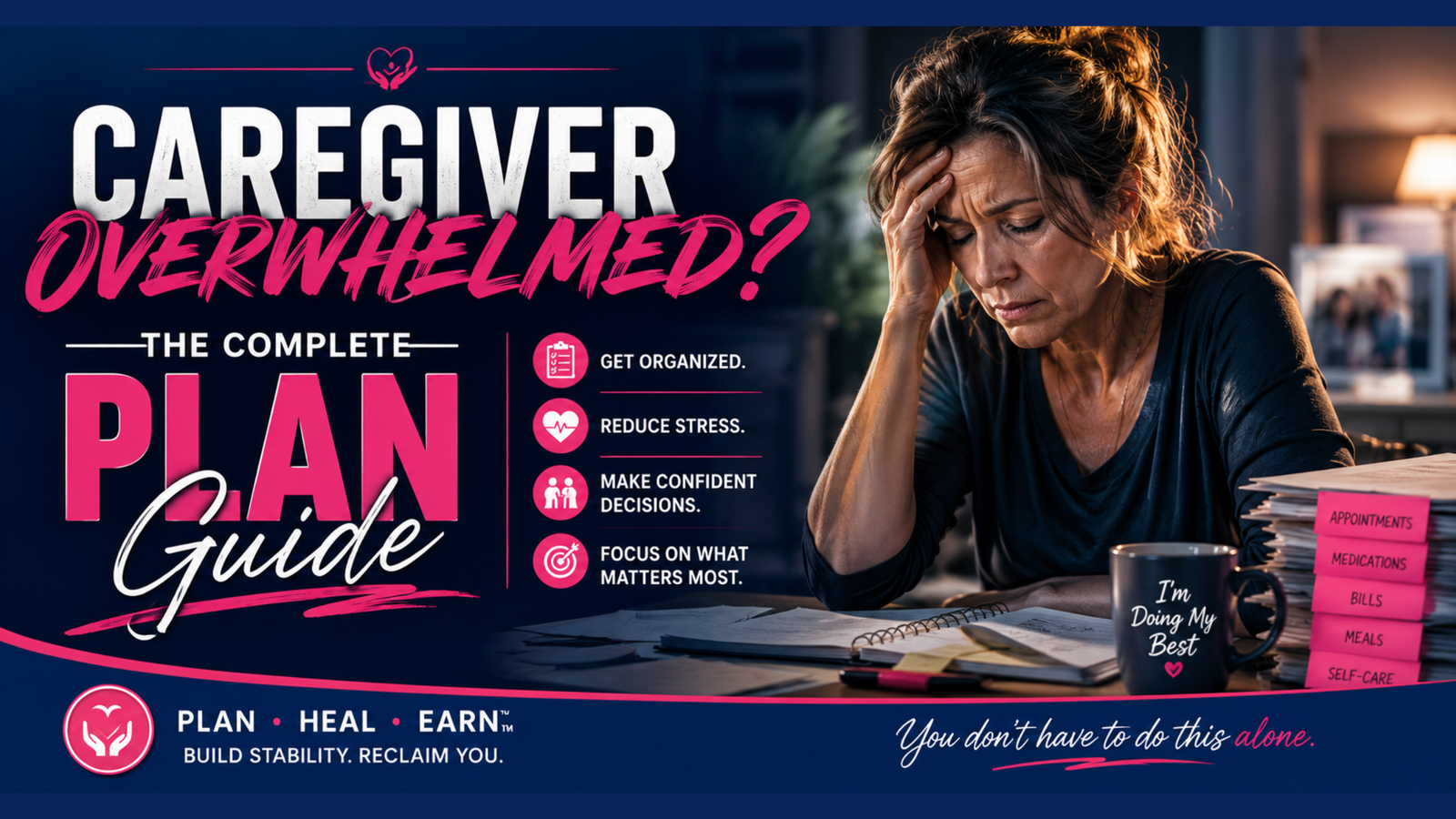
Caregiver Overwhelm? The Complete PLAN Guide to Getting Organized
Caregiver Overwhelm doesn’t happen overnight. One day you are living your life. The next you are managing medications, appointments, and decisions that used to belong to someone else, and no one sat you down to explain any of it. Whether you started yesterday or five years ago, that caregiver overwhelm never really goes away on its own. It takes real structure.
If you are reading this because you feel like you are experiencing caregiver overwhelm, barely keeping your head above water, you are not alone, and you are not doing this wrong. Caregiving rarely comes with warning or instructions. Nobody trains you to be a caregiver. You just wake up in it. New or years in, the medications, the appointments, and the decisions no one prepared you for pile up fast, and without structure they take over.
This guide is built from real caregiving experience, not theory. It walks through the same structure used with families every day: start by grounding yourself, get an honest picture of where things actually stand, build simple systems that hold everything together, and protect your own stability along the way.
You Are Not Behind; You Are Experiencing Caregiver Overwhelm
Before any checklist or tracker, something more important needs to be said. You are not behind. You are not doing this wrong. Caregivers often carry a quiet pressure to know more, do more, and hold up better than anyone reasonably could. If you have felt caregiver overwhelm, exhaustion, confusion, or even resentment, those feelings are not weakness. They are proof of how deeply you care, and they deserve acknowledgment before anything else.
You are not behind. You are exactly where you need to be, taking it one day at a time.
Get an Honest Picture of Where Things Stand
Structure only works when it is built on reality, not on how you wish things looked. Most caregivers start out trying to hold it all in their head, until something falls through and it feels like your fault. It was never a memory problem. It was a structure problem, and nobody sits down at the start to tell you what to expect. Before you can build anything real, you have to take an honest look at what caregiving actually looks like in your life right now, not what you think it should look like.
- Daily responsibilities. Medication management, meal preparation, hygiene and personal care, mobility assistance, medical appointments, emotional support, home maintenance, financial management, and coordinating outside help. Very few caregivers do all of this alone, but many feel like they should. Look at this list and ask yourself honestly which of these fall on you right now, and which part of the day feels the heaviest. That is where structure needs to go first, especially during caregiver overwhelm.
- What is falling through the cracks? Every caregiver has a version of this. Maybe it is a medication that got taken twice because two people thought they were handling it. Maybe it is an appointment you almost missed, or bills that pile up because there is no time left in the day. What are you forgetting? What feels disorganized? What is giving you caregiver overwhelm? What keeps you up at night replaying what you might have missed? This is not a judgment. Nobody expects you to have built a perfect system on day one, or even year five. This is simply the starting point every solution is built on.
Build Your Daily Care Structure
Once you know where things stand, structure creates calm. This is what turns caregiver overwhelm into something manageable: a simple, repeatable system for the pieces of caregiving that used to live only in your head. When everything depends on memory, one bad night’s sleep or one stressful day can bring it all down. A written structure does not depend on your memory holding up. It holds up on its own, even on the days you cannot.
- Daily routine. A basic morning, afternoon, and evening structure for caregiving tasks, so you are not reconstructing the day from memory every single time. This alone is one of the fastest ways to reduce caregiver overwhelm, because you stop starting from zero every morning.
- Medication tracker. Every medication, dosage, and schedule recorded in one place: medication name, dosage, time, and any notes about how it should be taken. Medication mix-ups are one of the most common and most preventable sources of caregiver overwhelm, and a simple tracker closes that gap.
- Appointment tracker. Every doctor and provider, date and time, purpose of the visit, and any follow-up needed, so nothing important slips through. When appointments live in one place instead of scattered across texts and sticky notes, a huge piece of the mental load disappears.
A Full Home Safety Check
Walk through your home and check off what has already been addressed, then return to this list regularly as needs change. A safe home prevents a lot of the emergencies that create caregiver overwhelm in the first place. Falls, burns, and missed medical alerts are often the moments that push a manageable situation into a crisis, and most of them are preventable with a few changes.
- Fall prevention. Remove loose rugs and tripping hazards, install grab bars in the bathroom, secure stair railings, and keep pathways clear throughout the home.
- Night lights in hallways and the bathroom, light switches reachable from the bed, and adequate outdoor lighting.
- Bathroom safety: a non-slip mat in the shower or tub, a raised toilet seat if needed, and a safe water heater temperature setting.
- Emergency preparedness. Emergency contacts posted somewhere visible, a medical alert device if appropriate, and important documents kept in one accessible location.
Build Your Emergency Plan Before You Need It
Having this ready means you will not have to think in a crisis. Emergencies are when caregiver overwhelm hits hardest, because you are being asked to make clear decisions under enormous stress. Fill this out now while you are calm, so the plan thinks for you later: primary and secondary emergency contacts, preferred hospital, your loved one’s physician and phone number, known allergies, current medications, insurance information, and any advance directive or DNR on file.
Stabilize Yourself, Not Just the Care Plan
You cannot pour from an empty cup. Your stability is part of the plan, not an afterthought. So much caregiver overwhelm comes from believing your own needs have to wait until everything else is handled. They do not. They cannot, because everything else depends on you.
- Your energy. Know what drains you and what restores you. Even five minutes of restoration matters. Small acts of self-care are requirements, not indulgences.
- Asking for help. Identify three specific things someone else could do for you this week, and who in your life could help if they only knew what you needed. Vague requests get vague responses. Specific ones get help.
- You are allowed to have them. A few scripts worth keeping ready:
“I can’t take that on right now, but I can help with this instead.”
“I need help with this. Would you be willing to step in?”
“This is hard for me to say, but I’ve reached my limit on this one.”
- Your own health. Track your average hours of sleep, whether you are eating regularly, when you last saw your own doctor, and your stress level right now. Your health is the foundation every care decision depends on.
Signs You May Need More Than a Plan
There is no shame in recognizing you need more support than any workbook or checklist can provide. Caregiver overwhelm does not always stay at a manageable level, and knowing the difference matters.
- You feel emotionally numb or detached
- You are exhausted even after rest
- You feel hopeless or trapped
- Your own health is deteriorating
- You are withdrawing from people you care about
- You feel resentful of the person you are caring for
- You are making more mistakes than usual
If three or more of these sound familiar, please reach out for support. You deserve it, and so does the person you are caring for.
Your Simple Next Steps
You do not have to do everything. You only have to do the next right thing. This is how caregiver overwhelm gets smaller, one week at a time instead of all at once.
- Week 1, Organization. Gather documents, create a basic care profile, and identify your biggest gaps.
- Week 2, Routine. Build your daily care structure and start using the medication and appointment trackers.
- Week 3, Ask for Help. Identify one person you can ask for support this week, using the scripts above.
- Week 4, Adjust and Stabilize. Review what is working, let go of what isn’t, and give yourself credit for the ground you have gained.
If you would rather not figure out these four weeks alone, that is exactly what the Caregiver Stability Plan was built for. Instead of you piecing this together between appointments and everything else on your plate, we build it with you: your daily structure, your trackers, your safety check, and your emergency plan, all set up around your specific situation instead of a generic template. You bring the reality of what you are dealing with, and we bring the structure. Nobody hands you a workbook and walks away. It becomes something you can actually stand on.
Where to Go From Here
This guide gives you the framework. If you want it built specifically around your situation, without having to figure it out alone, that is exactly what the Caregiver Stability Plan is for.
Free guide, I Am More Than a Caregiver: https://caregivingexpert.gumroad.com/l/Morethanacaregiver
The Caregiver Reset, $27: https://caregivingexpert.gumroad.com/l/Reset
The Caregiver Stability Snapshot, $197: https://theultimatecaregivingexpert.com/caregiver-stability-snapshot/
The Caregiver Stability Plan, $500: https://theultimatecaregivingexpert.com/caregiver-stability-plan/
You are doing something enormously hard, and you were never handed a manual for it. Structure will not make caregiving easy, but it will make it sustainable: one plan, one day, one right next thing at a time.