
10 Essential Printable Templates Every Family Caregiver Needs

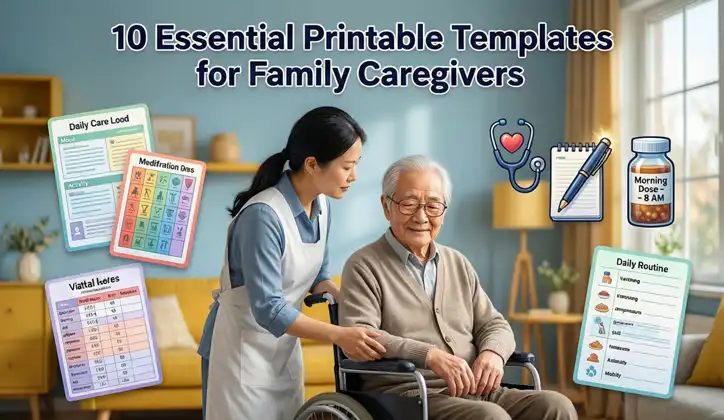
While it’s an honor to care for your family or a loved one, feeling overwhelmed as a family caregiver is very common. When you’re managing medications, doctor’s appointments, and daily routines all at once, things can quickly become chaotic.
That’s why organization in caregiving isn’t a luxury it’s a necessity. Using essential printable templates for family caregivers helps bring structure, clarity, and consistency to your daily responsibilities. These simple tools make it easier to track important details, stay on schedule, and communicate clearly with other family members.
Printable caregiving templates and charts improve transparency, reduce mistakes, and significantly increase patient safety. More importantly, proper documentation lowers your mental load, reduces stress, and brings peace of mind to the entire family—so you can focus on what truly matters: providing compassionate, reliable care.
Why Printable Templates Are Essential for Caregiving
Human memory often fails under stress. According to the National Institute on Aging (NIA), stress and lack of sleep directly affect our ability to make decisions. When a caregiver is tired, they are at risk of forgetting medication doses or times.
This is where the printable template comes in. It acts as a legal and protective shield between you and your patient. The State Department of Aging often recommends that proper documentation be provided so that paramedics or doctors can respond quickly in an emergency. Having a written record eliminates misunderstandings and helps maintain quality of care.
10 Essential Templates Every Caregiver Needs
1. Daily Caregiver Log Sheet
It is essentially a mirror of the patient’s daily activities. It records changes in eating, drinking, mood, and physical condition.
Why is it needed: Not paying attention to subtle daily changes can lead to major health risks.
What will be there: Hydration levels, food intake, sleep time, and any special behaviors.
For whom: Especially for patients with dementia or long-term illnesses.
If your loved one becomes restless in the evening, our Sundowning Workbook may be useful to you.
2. Caregiver Medication Log Template
A specific chart to record the name, dosage, and timing of the medication.
Why is it needed: Taking the wrong medicine or a double dose can be fatal. This template ensures the safety of the medicine.
What will be there: Name of the medication, milligrams, time, and whether there were any side effects.
For whom: Those who take more than 5 medications daily (Polypharmacy).
If the patient refuses to take the medicine, you should contact us. You can take a workbook, Medication Refusal in Caregiving.
3. Emergency Contact List
Keep the most important phone numbers organized on one page.
Why is it needed: Wasting time looking for numbers in times of danger means putting your life at risk.
What will be there: Numbers of doctors, nearby hospitals, pharmacies and family members.
For whom: Mandatory for everyone, especially those who live alone.
4. Elderly Caregiver Daily Checklist
A checklist of routine tasks from morning to night.
Why is it needed: Caregivers should not neglect essential patient care due to their busy personal work.
What will be there: Bathing, brushing teeth, exercising and changing dressings.
For whom: For post-hospital recovery or bedridden patients.
To help care for patients suffering from arthritis pain, we Arthritis Workbook for CaregiversLook.
5. Medical History Summary
A brief record of all the patient’s past illnesses, surgeries, and allergies.
Why is it needed: This is essential for a quick briefing when visiting a new doctor or in an emergency.
What will be there: Blood group, chronic illness, surgeries in the last 3 years, and drug allergies.
For whom: For senior citizens who have multiple health conditions.
6. Doctor’s Visit Planner
A form to write down questions and follow-up instructions before a doctor’s appointment.
Why is it needed: Many times when we go to the doctor’s office, we forget to ask important questions.
What will be there: Current symptoms, medication refill list, and new advice from the doctor.
For whom: For patients on regular follow-up.
If you have transportation problems or are worried about driving when going to see a doctor, collect the Driver’s License Workbook.
7. Vital Signs Tracker
Charts to track blood pressure, sugar levels, and pulse rate.
Why is it needed: For heart or diabetes patients, monitoring vital signs can be life-saving.
What will be there: BP readings, glucose levels, weight and oxygen saturation.
For whom:For hypertensive and diabetic patients.
If the patient suffers from dizziness or balance problems, we may be helpful Vertigo Workbook.
8. Caregiver Shift Handover Note
If multiple people provide services together, it is a means of exchanging information.
Why is it needed: If information from one shift does not reach another shift, a gap is created in service.
What will be there: When was the last meal given, time for the next medication, and special observations.
For whom: For professional caregivers or large families.
If you are overseeing the care of a loved one from a distance, our Long-Distance Caregiving Workbook is the best solution for you.
9. Grocery & Supplies Inventory
List of food and medical supplies needed by the patient.
Why is it needed: Don’t run out of essential items like insulin or adult diapers at the last minute.
What will be there: Stock level, refill date and required brand name.
For whom: Those managing in-home care.
If you have trouble organizing your service equipment, use our Hoarding Workbook।
10. Self-Care Journal for Caregivers
A place for caregivers to write down their own mental state.
Why is it needed: It is important to take care of your feelings to prevent burnout.
What will be there: Today’s challenge, time spent for yourself and a gratitude list.
For whom: For all family caregivers.
Are you tired of being overly stressed? Collect our Caregiver Burnout Recovery and Emotional Health Workbook.
How These Templates Support Core Caregiving Competencies
To be a good caregiver, you need to acquire certain core competencies. Our templates directly improve those competencies:
- Safety & Compliance: Proper documentation ensures that the patient is receiving the right care at the right time. Even simple problems like constipation can sometimes be complicated, which is why we Constipation Workbook. It is easy to track with.
- Communication Competency: Communication skills are enhanced by sharing accurate information with doctors or other family members. Learning first aid techniques is essential for us. Compassionate Care 101The guide is helpful.
- Observation & Reporting: Using a vitals tracker and daily log sharpens a caregiver’s observation skills. Our Sensory Deficit Workbook is especially helpful for those with hearing or vision problems.
Why Checklists & Logs Reduce Caregiver Stress
The hardest part of caregiving is dealing with uncertainty. When you have a written checklist, the “fear of forgetting” is removed from your mind. Studies have shown that those who document regularly have a much lower rate of ‘Caregiver Burnout’.
The checklist doesn’t reduce your workload, but it helps you save mental energy. In addition to the service, it will help you organize your family’s finances. Caregivers’ Cashflow Plan।
Free vs Paid Printables: Which One Should You Choose?
There are plenty of free templates available on the internet, but most of them are fragmented. You might get a medication log from one place but have to go to another site for a daily checklist.
On the other hand, a Paid Caregiver Printable Bundle gives you consistency and a complete solution. It has all forms in the same format, which looks professional and is easy to use. It is wise to purchase a premium bundle to save time and plan for long-term caregiving.
FAQs about Printable Templates for Family Caregivers
What are the 10 principles of caregiving?
The 10 core principles of caregiving are: maintaining confidentiality, protecting dignity, promoting independence, ensuring safety, effective communication, empathy, patience, consistency, proper observation, and self-care.
What are caregivers not allowed to do?
A family or unlicensed caregiver generally cannot directly perform any medical procedures (such as giving injections or inserting a catheter) unless they have received professional training. In addition, it is illegal to force a patient’s legal or financial decisions.
What do family caregivers need most?
What family caregivers need most are the right resources or information, emotional support (respite care), and disciplined organizational tools. With the right guidelines, their workload can be halved.
What are the 5 common tasks of a caregiver?
The 5 common tasks of a caregiver are: personal care, medication management, meal preparation, doctor communication, and emotional and social support.
Conclusion
Caring for your loved one is a noble responsibility, but you don’t have to sacrifice your peace of mind to do it. Instead of trying to memorize everything, rely on the system. Our templates will give you the mental strength and clarity that will make your daily caregiving journey easier.
Collect the Caregiver templates you need today and bring professionalism and peace of mind to caregiving.