

Caregiver Blog
Family Caregiver Compensation Programs by State: 7 Best Places to Look

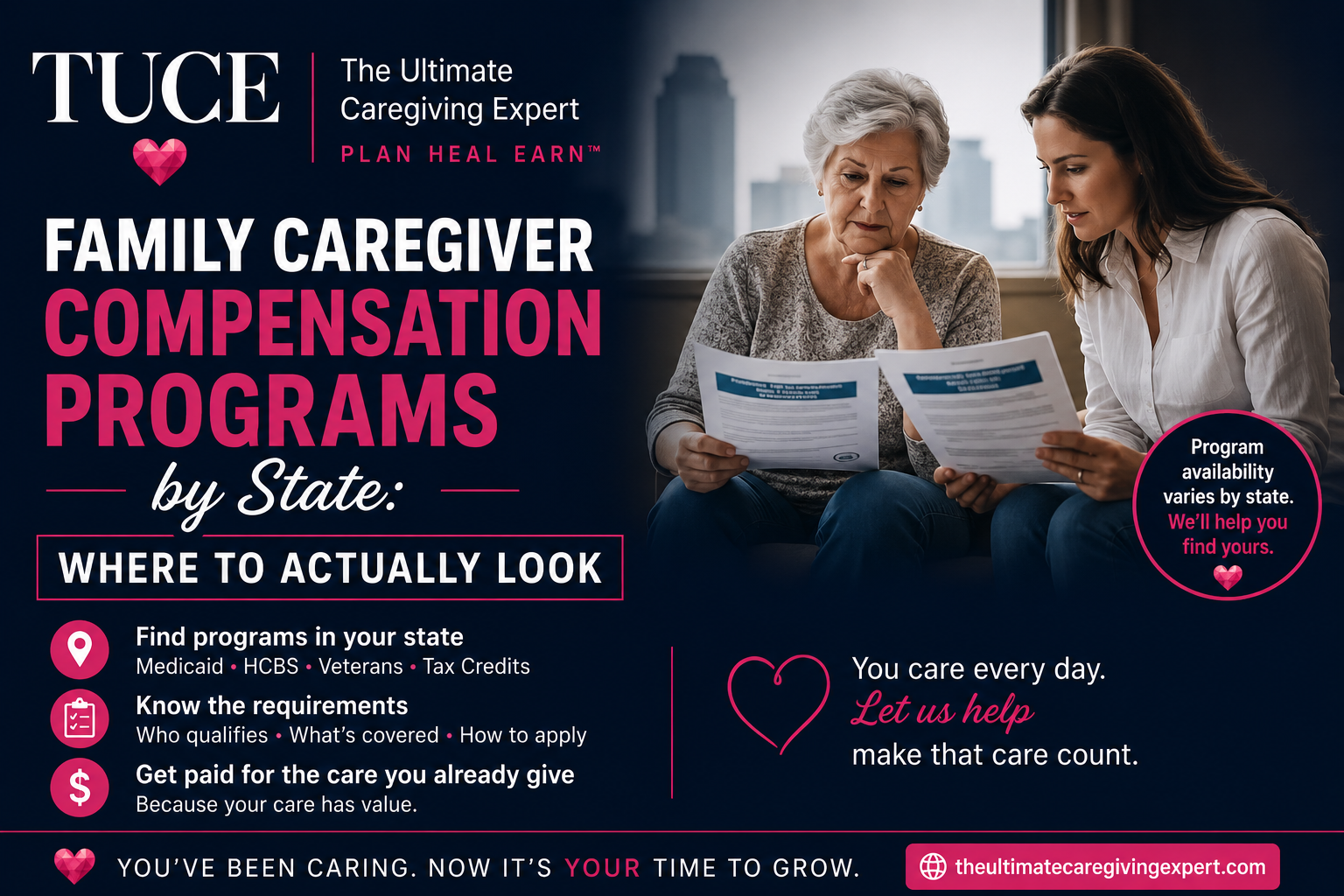
Family Caregiver Compensation Programs by State: Where to Actually Look
A clear starting point for finding Medicaid and Medicare related compensation programs, since the answer depends entirely on where the care recipient lives
Family caregiver compensation programs by state are one of the most confusing topics in caregiving, not because the information does not exist, but because there is no single national answer to give. Medicaid is a federal program administered individually by each state, which means eligibility rules, program names, and application processes are genuinely different depending on where the care recipient lives. A program that exists in one state may not exist at all in another, or may exist under a completely different name with different requirements. This is exactly why a generic search so often leaves caregivers more confused than when they started.
Understanding family caregiver compensation programs by state requires looking beyond general caregiving information and finding the specific rules that apply where the care recipient lives. The right program, eligibility requirements, and application process can all depend on that location.
In this post: why there is no single national answer, what Medicare actually does and does not cover, how self directed care programs generally work, how to track down your specific state’s program, and what to have ready before you apply.
Family Caregiver Compensation Programs by State: Why There Is No Single National Answer
Medicaid is not one program, it is administered through individual state programs operating under shared federal guidelines. That structure is exactly why searching family caregiver compensation programs by state and expecting one clean answer almost never works. What is true for a neighbor in another state, or even a cousin one state over, may not apply to your situation at all.
This is not a flaw in how you are searching. It is simply how the system is built. The most useful mindset going in is treating this as a state specific research project from the start, rather than expecting a single universal answer to exist somewhere online.
For family caregiver compensation programs by state, the care recipient’s location is one of the first details to establish. Starting with that information can help you avoid spending time researching programs that are not available where you actually live.
The most important thing to remember is that family caregiver compensation programs by state are not interchangeable. Eligibility in one state does not automatically create eligibility in another.
What Medicare Does and Does Not Cover
Medicare is different from Medicaid, and it is important not to confuse the two, especially since so many caregivers assume Medicare will help here and it usually does not. Medicare generally does not pay family members directly for caregiving. It can cover certain home health services under specific conditions, such as skilled nursing visits ordered by a doctor, but ongoing family caregiving compensation is a Medicaid, VA, or private program question, not a Medicare one.
Understanding this distinction early saves a lot of wasted time. If you find yourself searching Medicare caregiver pay and coming up empty, that is not a sign you are searching wrong, it is a sign you may be looking in the wrong program entirely.
When researching family caregiver compensation programs by state, it helps to separate Medicare questions from Medicaid questions from the beginning. This makes it easier to direct your research toward the program that may actually address your situation.
Medicare and Medicaid can both appear in caregiving conversations, but they serve different purposes. Knowing which program you are researching can save you from following the wrong application path.
How Self Directed Care Programs Generally Work
Many states offer some version of a self directed, consumer directed, or participant directed care program under Medicaid, where an eligible person receives a budget for home care and can choose their own caregiver, sometimes including a family member. The structure is broadly similar across states, an assessment establishes need, a budget is set, and the recipient or their representative manages hiring, but the specific name of the program, the exact eligibility rules, and which family members can be paid all vary by state.
Spousal caregivers in particular are sometimes excluded from being paid under these programs, depending on the state, so this is a detail worth confirming directly rather than assuming either way.
This variation is one of the main reasons family caregiver compensation programs by state need to be researched individually. A program structure that sounds promising may have specific rules about who can serve as the paid caregiver, what type of care qualifies, and how the care recipient must qualify.
If you are researching family caregiver compensation programs by state, pay close attention to the words self directed, consumer directed, and participant directed. Different states may use different terminology for programs that have similar basic structures.
A Real Example of How This Plays Out
Consider two families in different states, both caring for a parent with similar needs. One family lives in a state where the self directed care program allows a daughter to be hired and paid directly through a Medicaid budget. The other family, in a different state, discovers the same type of program exists but explicitly excludes adult children from being paid caregivers, only allowing non relative caregivers under that particular state’s rules.
Neither family did anything wrong. The programs are simply built differently. This is the exact reason family caregiver compensation programs by state require individual research rather than general assumptions carried over from what worked for someone else.
The example also shows why caregivers should avoid assuming that another family’s experience automatically applies to them. Even when two families have similar caregiving responsibilities, the rules governing compensation may be different.
A family caregiver compensation program can sound like the right solution while still having eligibility requirements that make it unavailable to a particular caregiver. That is why confirmation from the agency responsible for the program matters.
How to Find Your Specific State’s Program
The most reliable path is your state’s Medicaid or Health and Human Services website, searched for terms like self directed care, consumer directed care, or participant directed services, combined with your state’s name. Your local Area Agency on Aging is also a reliable, free resource for this exact question.
For general information on how Medicaid programs work and how to locate your state’s specific contacts, the official Medicaid website is a reliable federal starting point before you narrow down to your own state’s rules.
If the care recipient in your situation is a veteran, it is also worth revisiting whether VA benefits apply, since those programs run separately from Medicaid and have their own compensation structure. Our post on getting paid to care for a family member walks through that path in more detail.
When researching family caregiver compensation programs by state, write down the name of every program or waiver you are directed toward. This makes it easier to continue your research and compare the requirements without starting over each time.
You can also keep a simple record of the website you found, the agency you contacted, the person or department that answered your questions, and the next step they recommended. This can make a complicated research process much easier to manage.
What to Have Ready Before You Apply
Most programs will ask for documentation of the care recipient’s medical condition and functional needs, financial information to establish Medicaid eligibility, and identifying information for the proposed caregiver. Gathering this ahead of the first contact tends to shorten the process considerably, since these applications rarely move quickly once they are missing paperwork.
It also helps to write down your questions before contacting the appropriate agency. Ask specifically whether the program allows family members to be paid caregivers, whether spousal caregivers are included or excluded, and what the current wait time looks like for an assessment. Getting clear answers to these questions early can save weeks of follow up later.
If you are researching family caregiver compensation programs by state for the first time, keep a simple record of the agencies you contacted, the programs they mentioned, and any documents they said you would need. This gives you a clear reference point as you move through the process.
Before applying, it is also useful to ask whether the program has an enrollment limit, whether there is a waiting list, and whether the caregiver must complete separate paperwork from the care recipient. These details can affect how long the process takes.
What Happens if Your State Does Not Have a Clear Program
Not every state makes this easy to find, and some genuinely have more limited options than others. If your first search does not turn up a clear answer, ask directly whether a waiver program exists, since many self directed options are technically run as Medicaid waivers with their own separate application process and waiting list.
It can take more than one attempt to reach someone who knows the full picture, and that is normal, not a sign you are missing something obvious. When researching family caregiver compensation programs by state, persistence can matter because the information may be spread across several agencies or program pages rather than presented in one simple location.
It also helps to know that waiver programs commonly have enrollment caps, meaning a state can technically have the program available while also having a waiting list that runs months or even longer. Asking directly about current wait times during your initial call, rather than assuming approval means immediate start, sets more realistic expectations from day one.
If the first person you speak with cannot answer your questions, ask which department handles self directed or consumer directed care. Getting redirected to the right department is often more productive than repeating the same general search.
Realistic Timelines Worth Planning Around
Even in states with a clear, active program, approval rarely happens immediately. Between the initial assessment, verifying financial eligibility, and processing the caregiver’s paperwork, most families should expect this process to take several weeks at minimum, sometimes longer if a waiver waiting list is involved.
Planning your household finances as though compensation might take a while to arrive, rather than assuming it will begin immediately, tends to prevent a lot of unnecessary financial stress during the waiting period.
This is particularly important when researching family caregiver compensation programs by state because finding a program does not necessarily mean that payment will begin right away. Eligibility, assessment, enrollment, documentation, and available program capacity can all affect the timeline.
A realistic plan allows you to continue meeting household expenses while you wait for an assessment or application decision. That way, you are not depending on potential compensation before you know whether you qualify.
Questions to Ask Before You Move Forward
Once you identify a possible program, make sure you understand what happens next. Ask whether the care recipient must complete an assessment, whether the caregiver must meet specific requirements, whether family members can be paid, and whether the program currently has available enrollment.
It is also useful to ask which agency manages the program and where applications are submitted. Some caregivers lose time because they find information about a program but do not immediately identify the agency responsible for the next step.
A clear list of questions can make researching family caregiver compensation programs by state much easier and can help you recognize when you have reached the right department.
Before ending the conversation, ask for the name of the program, the next application step, the documents you need, and the best place to follow up if you do not receive a response. Having these details written down can make the process much easier to continue.
Where to Go From Here
If sorting out which program actually applies to your state feels like the hardest part, the Caregiver Cashflow Plan helps you build a realistic income plan around your caregiving situation, whether or not a compensation program ends up coming through.
Free guide, I Am More Than a Caregiver: https://caregivingexpert.gumroad.com/l/Morethanacaregiver
The Caregiver Cashflow Plan, $27: https://caregivingexpert.gumroad.com/l/cashflow
The Caregiver Stability Snapshot, $197: https://theultimatecaregivingexpert.com/caregiver-stability-snapshot/
The Caregiver Stability Plan, $500: https://theultimatecaregivingexpert.com/caregiver-stability-plan/
Family caregiver compensation programs by state can take time to understand, but that does not mean the process has to remain confusing. Start with the care recipient’s state, identify the Medicaid or related program that may apply, confirm the eligibility rules, and keep track of every step you take. The goal is not to find a generic answer that applies to everyone. The goal is to find the specific information that applies to your family and use it to make your next decision with greater confidence.