

Caregiver Blog
Turn Caregiving Experience Into a Career: 7 Powerful Ways to Succeed

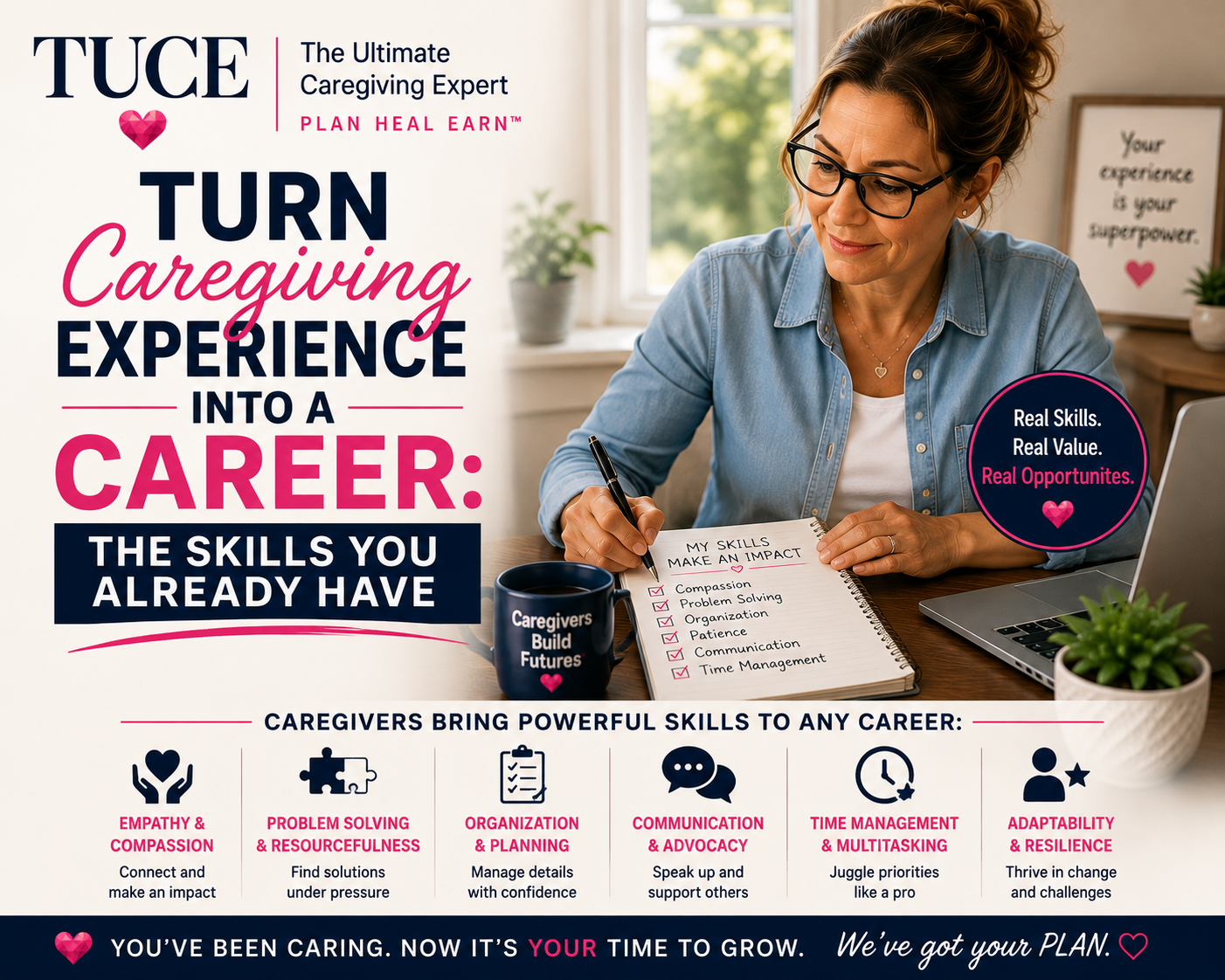
urn Caregiving Experience Into a Career: The Skills You Already Have
Ask most family caregivers to list their professional skills and the answer is almost always the same, none. Then in the very next breath they will describe coordinating five specialists, managing a medication schedule without a single error, and talking a hospital discharge team into holding one more night until home care was actually ready.
Learning how to turn caregiving experience into a career starts with recognizing the gap between what caregivers actually do every day and what they believe they are qualified for. The skills were never missing. They were just never named.
If you have spent months or years managing appointments, communicating with healthcare professionals, solving unexpected problems, organizing information, advocating for someone you love, or keeping a complicated household running, you have developed skills that can have value in the workplace.
In this post, you will learn why caregivers undersell their own experience, which specific skills transfer directly into paid roles, the career paths built around lived caregiving experience, a real example of what this can look like, and exactly how to talk about your caregiving years on a resume without apologizing for them.
Why Caregivers Undersell Themselves
Ask a family caregiver to list their skills and most will say they do not have any relevant experience, then in the same conversation describe coordinating five specialists, managing a medication schedule with zero errors, and advocating successfully through a hospital discharge. The skills are there. The habit of calling it just what you do for family is what is hiding them.
Part of this comes from how caregiving happens. Nobody hands you a job title. There is no orientation, no performance review, no manager telling you that what you just did with the insurance company was a real, valuable skill. You just did it, because someone needed you to, and you moved on to the next thing. Over years, that adds up to a resume worth of experience that never once felt like a job while it was happening.
This is also why so many caregivers freeze up at the idea of turning caregiving experience into a career. It does not feel like career material because it never came with a title, a paycheck, or anyone telling you it counted.
But skill does not require a job title to be real. It requires being done, under pressure, repeatedly, and getting better at it over time. That already happened, whether anyone ever called it a job or not.
The first step to turn caregiving experience into a career is recognizing what you already know how to do and learning how to describe those abilities in language employers understand.
Once you start looking at your caregiving responsibilities through that lens, ordinary tasks can begin to look very different. Coordinating appointments becomes organization. Communicating with providers becomes professional communication. Managing a crisis becomes problem solving. Advocating for someone becomes advocacy.
The Skills You Already Have
Care coordination. Managing multiple providers, appointments, and information across a complex situation is genuinely close to project management, the kind companies pay salaries for. If you have ever kept three specialists, a pharmacy, and a home health schedule from colliding in the same week, you have already done the job.
Medical literacy. Years of appointments, medication management, and reading test results translate directly into health related roles. You likely understand more about how the healthcare system actually works than most people who have never had to navigate it for someone they love.
Crisis management. Staying functional and making clear decisions during a medical emergency is a real, valued skill in many workplaces. Every time you kept your head while everyone around you did not, that was proof of a skill employers specifically look for.
Patient advocacy. Learning to push back on a system respectfully but persistently until someone gets the right care maps directly onto roles built around exactly that. This is not a soft skill. It is a learned, transferable one, and it is one of the clearest ways to turn caregiving experience into a career people will actually pay you for.
Communication. Caregivers regularly communicate with doctors, nurses, insurance representatives, family members, pharmacies, and other professionals. Learning to explain a complicated situation clearly, ask the right questions, and follow up when something is unresolved is valuable in almost any workplace.
Organization. Managing appointments, medications, paperwork, bills, transportation, and changing priorities requires a level of organization that many employers actively value. If you have kept a complicated caregiving system running, you already have evidence that you can manage competing priorities.
Problem solving. Caregiving rarely goes exactly according to plan. You learn to adjust quickly, find another option, and keep moving when the original plan stops working. That ability to solve problems under pressure is one of the strongest skills you can carry into a new career.
These skills are not just useful during caregiving. They can become part of the professional story you tell when you are ready to turn caregiving experience into a career.
Career Paths Built Around This Experience
Home health aide and certified nursing assistant roles often have accessible entry paths and value real world caregiving experience highly. Many of these roles will train you further, but they are looking for exactly the instincts you already have.
Care management and patient navigator roles, at hospitals, insurers, and care agencies, are built around many of the skills a family caregiver already has, coordinating care, communicating across providers, and keeping a complicated situation moving forward.
Patient advocacy is a field where lived caregiving experience can provide valuable perspective. Community health work and case management are also close to this, often requiring strong communication, organization, and the ability to help people navigate complicated systems.
Administrative support, virtual assistance, customer support, and other service based roles can also make sense for caregivers who want to use their organizational and communication skills outside of healthcare. The right path depends on your existing experience, training, schedule, and the type of work you want to pursue.
If you want a general sense of how these healthcare support roles are classified and what they typically involve, the U.S. Bureau of Labor Statistics Occupational Outlook Handbook is a reliable place to look before you apply anywhere.
The important thing is not to assume that there is only one way to turn caregiving experience into a career. Your existing skills can connect to several different types of work.
You may also discover that the best career path combines your caregiving experience with skills you developed before you became a caregiver. Your previous professional experience still counts. Caregiving can add another layer of valuable knowledge rather than replacing everything that came before it.
What This Can Actually Look Like
Picture a caregiver who spent three years managing her mother’s diabetes, coordinating four specialists, and handling every insurance appeal that came through the mail.
On paper, she has a three year gap. In reality, she has three years of care coordination, medical literacy, crisis management, communication, and problem solving experience that a patient navigator role could value immediately, if she described it that way.
The shift is rarely about gaining a completely new skill. It is often about learning to describe a skill you already built in language a hiring manager recognizes.
That reframing can be the first practical step to turn caregiving experience into a career. The caregiver is not inventing experience. She is translating experience that already exists into language that employers can understand.
The same principle applies even if healthcare is not the direction you want to take. The goal is to identify the actual work you performed, identify the skill behind that work, and then connect that skill to a role that needs it.
For example, coordinating several appointments may demonstrate scheduling and organization. Managing paperwork may demonstrate attention to detail. Communicating with multiple people may demonstrate relationship management. Handling an unexpected problem may demonstrate adaptability.
Once you recognize those connections, the process of turning caregiving experience into a career becomes much less intimidating.
How to Talk About the Gap on Your Resume
Rather than leaving a caregiving period blank or vague, name it directly and describe it in the same language you would use for a job, using specific, active language.
Coordinated care across multiple providers.
Managed a complex medication schedule.
Advocated through insurance appeals and followed up until the issue was resolved.
Organized appointments and communicated with multiple healthcare professionals.
Managed changing priorities during unexpected situations.
These are real experiences. Framing them that way is what helps move caregiving from something that looks like an unexplained gap into something that demonstrates your abilities.
You do not need to exaggerate your caregiving experience or make it sound like something it was not. The goal is accuracy. Describe what you actually did, how often you did it, and what responsibilities you were personally responsible for managing.
If you want to turn caregiving experience into a career, your resume should make the connection between your caregiving responsibilities and your transferable skills easy for a hiring manager to see.
This same language works in an interview, not just on paper. When someone asks about the gap, do not apologize for it or rush past it. Say plainly what you did, using the same active verbs. Most interviewers have never had someone describe caregiving that clearly, and it tends to land as confidence rather than as an excuse.
Your goal is not to convince an employer that caregiving was a traditional job. Your goal is to show that the responsibilities you managed required real skills that can transfer into the position you are applying for.
How Long This Actually Takes
Learning to turn caregiving experience into a career is not usually an overnight shift, and it does not need to be.
Most caregivers who make this move do it in small, deliberate steps, rewriting a resume one evening, applying to one role, having one conversation with someone already in the field.
Small wins count here. One hour spent updating how you describe your experience is one hour closer than not starting at all, and that pace is sustainable in a way that trying to overhaul everything at once rarely is.
You also do not have to decide on your entire career before taking the first step. Start by identifying three skills you already use regularly. Then find several roles where those skills appear in the job description. Look at what employers are asking for and compare those requirements with what you already know how to do.
That process can make the path feel much more manageable and give you a clearer picture of where your experience fits.
How to Turn Caregiving Experience Into a Career Without Starting Over
One of the biggest misconceptions caregivers have is that changing careers means starting from zero. It often does not.
Your caregiving experience can become part of a larger professional story. You may already have work experience from before caregiving began, along with skills developed during caregiving and interests that have changed since then. The goal is to connect those pieces rather than treating your caregiving years as a completely separate chapter.
For example, someone with previous administrative experience who spent several years coordinating a family member’s care may have an especially strong story for healthcare administration, patient support, care coordination, or project based administrative work.
Someone with communication experience may find that advocacy, customer support, community outreach, or client services allow them to use both their previous professional skills and their caregiving experience.
You do not have to erase the career you had before caregiving. You can build on it.
That is an important part of learning to turn caregiving experience into a career. Your caregiving experience does not have to replace your previous professional identity. It can strengthen and expand it.
A Better Way to Think About Your Experience
If you are struggling to see your caregiving experience as career experience, stop asking yourself, “What job did I have?”
Ask instead:
What problems did I solve?
What responsibilities did I manage?
Who did I communicate with?
What systems did I learn to navigate?
What decisions did I make under pressure?
What did other people rely on me to handle?
Those questions often reveal skills that the word caregiver alone does not communicate.
This is the mindset shift that makes it possible to turn caregiving experience into a career without pretending your caregiving years were something they were not. You are not inventing experience. You are translating it.
Once you start thinking this way, you may notice that your caregiving history contains more professional value than you initially realized.
Building Confidence Before You Apply
It is normal to feel uncertain when you are preparing to turn caregiving experience into a career. You may compare yourself with applicants who have formal job titles, recent work history, or certifications that appear more impressive on paper.
Try not to make that comparison before you have translated your own experience properly.
Read several job descriptions for roles that interest you. Circle the skills and responsibilities that appear repeatedly. Then look back at your caregiving experience and identify moments when you performed those same functions.
You may discover that the connection is much stronger than you expected.
Confidence does not have to mean believing you are qualified for every role. It can simply mean being willing to recognize the experience you actually have and apply for opportunities where that experience makes sense.
The goal is not perfection. The goal is progress. Every resume revision, application, conversation, and new connection can make it easier to turn caregiving experience into a career that fits the person you are today.
What to Do Before Applying
Before sending out applications, take a little time to create your own skills inventory.
Write down the caregiving responsibilities you handled regularly. Then place each responsibility beside the professional skill it demonstrates.
For example, coordinating appointments can demonstrate scheduling. Communicating with healthcare providers can demonstrate professional communication. Managing bills and records can demonstrate organization and attention to detail. Handling unexpected situations can demonstrate problem solving and adaptability.
Next, compare those skills with actual job descriptions. Look for repeated words and responsibilities. This helps you understand how employers describe the skills you already have and gives you language you can use honestly on your resume.
This small exercise can make it significantly easier to turn caregiving experience into a career because you are no longer starting with a blank page. You are starting with evidence.
Where to Go From Here
If naming your skills is the easy part but figuring out how to actually turn them into steady income feels like the harder question, the Caregiver Cashflow Plan walks you through that exact step.
Free guide, I Am More Than a Caregiver: https://caregivingexpert.gumroad.com/l/Morethanacaregiver
The Caregiver Cashflow Plan, $27: https://caregivingexpert.gumroad.com/l/cashflow
The Caregiver Stability Snapshot, $197: https://theultimatecaregivingexpert.com/caregiver-stability-snapshot/
The Caregiver Stability Plan, $500: https://theultimatecaregivingexpert.com/caregiver-stability-plan/
The years you spent coordinating care were never wasted time. They were unpaid experience in skills people are hired for every day.
Learning to turn caregiving experience into a career starts with naming those skills, recognizing their value, and connecting them to opportunities that fit the life you are building now.
Your caregiving years do not have to remain a gap in your story. They can become part of the experience that helps you build what comes next.