

Caregiver Blog
Sandwich Generation Long Distance Caregiving: 4 Critical Challenges to Overcome

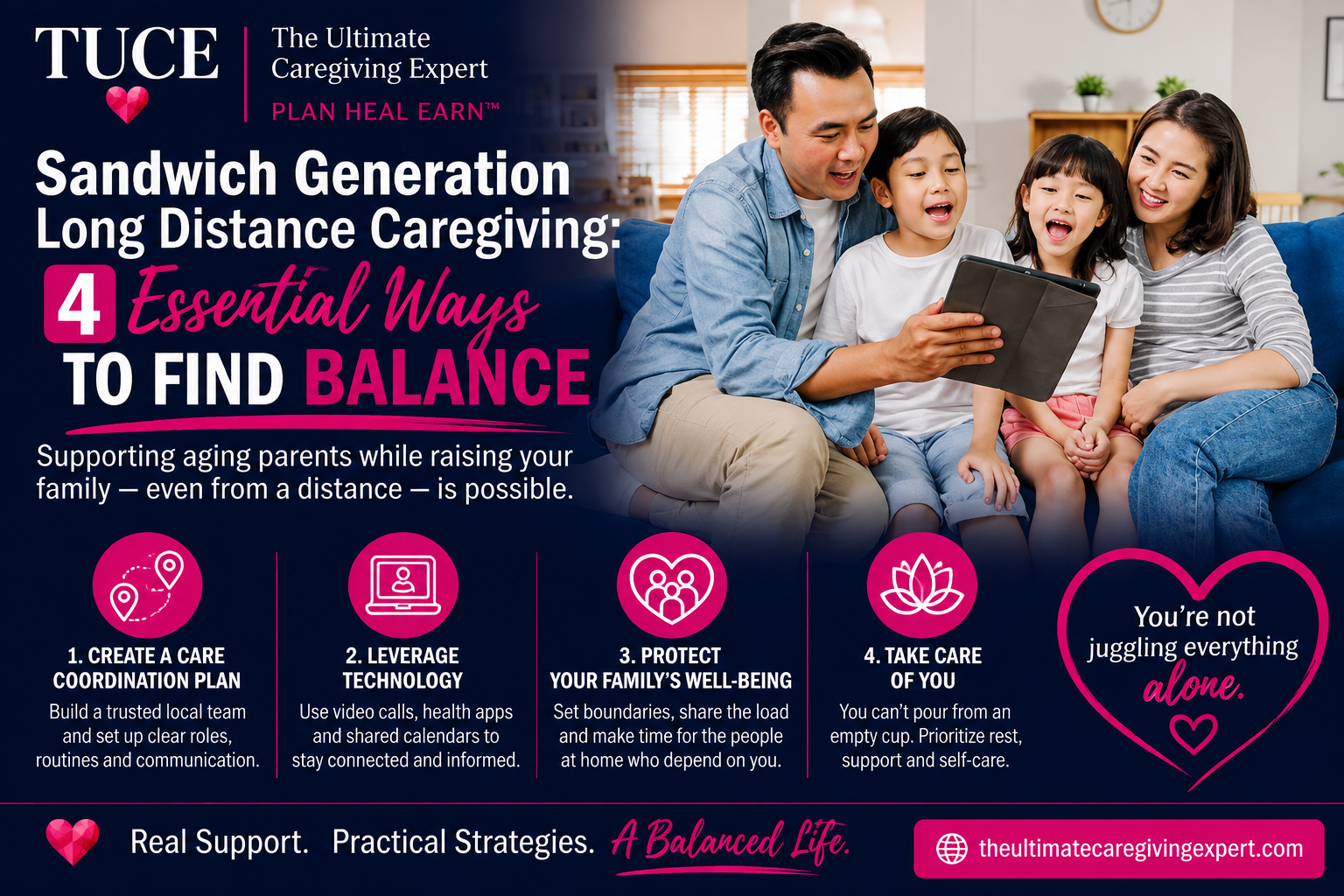
Sandwich Generation Long Distance Caregiving: 4 Critical Challenges to Overcome
Raising kids while caring for an aging parent is hard enough. Doing both when the parent lives in another state adds a whole new layer.
Sandwich generation long distance caregiving adds a layer of strain that neither responsibility alone fully prepares you for. Sandwich generation caregiving is already a full stretch of attention, with kids who need you present and a parent who needs you responsive. Add distance to one side of that equation, and the strain changes shape. It is no longer just about not having enough time. It is about not being able to physically be where you are needed most, on either side, at the same moment something happens.
Quick answer: Sandwich generation long distance caregiving means splitting your attention between children who need physical presence and a parent who needs remote coordination, often at the exact same moment. Building clear systems, protecting dedicated time for your kids, and establishing a predictable rhythm rather than constantly reacting to crises can make the situation much more manageable.
In this post: the real challenge of caring for two households at once, what genuinely has to happen locally versus what can be managed remotely, how to protect real time with your own kids, how to build a rhythm instead of constantly reacting, and answers to a few common questions.
The Math of Caring for Two Households at Once
Sandwich generation caregiving is already a full stretch of attention, with kids who need you present and a parent who needs you responsive. Add distance to one side of that equation, and the strain changes shape. It is no longer just about not having enough time. It is about not being able to physically be where you are needed most, on either side, at the same moment something happens.
This is one of the biggest challenges of sandwich generation long distance caregiving because distance removes the ability to respond physically when your parent needs you most. A parent nearby who needs help can be managed, even imperfectly, by simply going there. A parent far away removes that option entirely, and the guilt of not being able to physically show up often lands hardest during exactly the moments it matters most.
When you are managing sandwich generation long distance caregiving, it can help to stop thinking about your responsibilities as one enormous problem. Instead, separate them into the areas that require your direct attention, the areas that can be delegated, and the areas that can be handled through a reliable system.
That distinction can immediately make the situation feel less overwhelming.
Sandwich Generation Long Distance Caregiving: What Has to Happen Locally
Be honest about which tasks genuinely require physical presence and which can realistically be managed remotely.
• Medical appointments, home safety checks, and hands on care generally require someone physically present, whether that is you, a local paid caregiver, or a nearby relative.
• Bill paying, scheduling, and emotional check ins can realistically be managed remotely with the right systems in place.
• Medication management sits in between. Remote reminder systems can help, but someone local still needs to physically confirm that doses are actually being taken.
This distinction is what determines whether local paid help or a nearby relative is truly necessary, or whether the situation can be managed with strong systems instead.
Getting this distinction wrong in either direction, assuming everything needs your physical presence or assuming everything can be handled remotely, tends to create unnecessary strain.
For sandwich generation long distance caregiving to remain sustainable, your goal should not be to personally handle every responsibility. Your goal should be to make sure every important responsibility has a reliable person or system attached to it.
If you have not yet built the local support system this requires, our post on long distance caregiving walks through how to establish that support.
Protecting Time With Your Own Kids
The parent who is far away often ends up absorbing a disproportionate share of attention simply because their needs surface more urgently and unpredictably, by phone, by crisis, while the needs of kids who are right in front of you can be easier to quietly postpone.
This is one of the hardest parts of sandwich generation long distance caregiving because the emergency on the phone can feel impossible to ignore. At the same time, your children are experiencing their own needs, milestones, disappointments, and important moments.
Sandwich generation long distance caregiving requires you to recognize that both generations need intentional attention, even when you cannot respond to both at the same time.
Protecting specific, defended time for your children, not just leftover time, is worth treating as a real commitment rather than an afterthought.
A scheduled hour, with your phone silenced and dedicated entirely to your kids, tends to matter more to them than a much larger amount of distracted, interrupted time.
It also helps to name this pattern out loud to your kids, in age appropriate terms. Children often sense when a parent is emotionally elsewhere even when physically present. A simple explanation that grandma needs extra help right now tends to reduce confusion and resentment more than silence does.
The goal is not to give both generations exactly the same amount of attention. That may not be realistic. The goal is to make sure your children do not consistently receive only whatever attention remains after every caregiving demand has been handled.
Building a Rhythm Instead of Reacting to Crises
A predictable rhythm, scheduled calls, a regular check in system with any local support, and planned visits can reduce the sense that every single day carries the threat of an emergency call.
It will not eliminate real emergencies when they happen, but it changes the baseline from constant low grade dread to something more manageable.
For sandwich generation long distance caregiving, predictability is especially valuable because distance removes many of the spontaneous ways you might otherwise notice that something is wrong.
Instead of relying entirely on crisis calls, create regular points of contact and review.
Ask yourself:
• When will I speak directly with my parent?
• When will I communicate with the local support person?
• When will I review upcoming appointments?
• When will I plan my next visit?
• When will I protect uninterrupted time with my children?
Having answers to these questions creates a structure that can carry some of the mental load for you.
A Sample Weekly Rhythm
| Day | Focus |
|---|---|
| Monday | Scheduled call with parent’s local support contact |
| Wednesday | Check in call with parent directly |
| Friday | Review the week ahead, appointments and any needed follow up |
| Weekend | Protected, undistracted time with your own kids |
This is a starting template, not a fixed rule. The actual value comes from having some rhythm at all, rather than letting every day default to reactive crisis management with no underlying structure.
You can adjust the schedule according to your parent’s needs, your children’s schedules, your work responsibilities, and the availability of local support.
A Real Example of How This Plays Out
Consider a mother of two managing her own household while her father, three states away, was recovering from a hip replacement.
In the first few weeks, every day felt like an emergency. Phone calls came at unpredictable times, and she experienced constant low grade anxiety about what she might be missing.
Once she established a weekly call schedule with a local neighbor checking in on her father and blocked two specific evenings a week that were entirely for her kids, the anxiety did not disappear.
However, it stopped controlling every part of her day.
This example illustrates an important principle of sandwich generation long distance caregiving. A system does not have to eliminate every problem to be useful. Sometimes its greatest value is making problems more predictable and preventing one unexpected issue from consuming the entire week.
Four Critical Challenges of Sandwich Generation Long Distance Caregiving
The difficulties involved are not always about the actual caregiving tasks. Often, the hardest part is managing competing responsibilities at the same time.
Challenge 1: Divided Attention
Your parent may need help at the exact moment your child needs you. Because the two households are physically separated, there may be no easy way to satisfy both needs immediately.
A clear priority system can help you decide which situations require immediate action and which can wait.
Challenge 2: Physical Distance
You cannot be in two places at once. That means someone else may need to handle tasks that you would normally manage yourself.
Identifying trusted local support before an emergency occurs can make this challenge much easier to manage.
Challenge 3: Constant Communication
Phone calls, messages, appointments, updates, and questions can quickly become another full time responsibility.
Creating predictable communication times can reduce unnecessary interruptions while still ensuring your parent and local support network know when they can reach you.
Challenge 4: Protecting Your Family Life
Your children should not always receive the leftover pieces of your time.
Sandwich generation long distance caregiving becomes more sustainable when family time is treated as an important part of the caregiving system rather than something that happens only when nothing else needs your attention.
Frequently Asked Questions
How common is sandwich generation long distance caregiving?
Sandwich generation long distance caregiving is increasingly common as families spread across states for work and other life changes, though exact figures vary by source.
What matters practically is that the challenges it creates, split attention and physical distance, are consistently reported by caregivers in this situation.
Should I move closer to my aging parent if I am also raising kids?
This is a deeply personal decision with no universal right answer.
It depends on your children’s stability, your own work and support system, and how much local help your parent actually has.
It is worth deciding deliberately rather than out of guilt alone.
Before making a major move, consider what your parent actually needs, what support already exists locally, what your children need from you, and whether additional services could reduce the pressure without requiring your entire household to relocate.
How do I know if I am neglecting my kids while managing a parent’s care remotely?
Watch for patterns rather than single moments.
Repeatedly missed events, kids who have stopped asking for your attention, or your own sense that you cannot remember the last uninterrupted conversation you had with them are signals worth addressing directly rather than dismissing as temporary.
Sandwich generation long distance caregiving can make it easy to focus on the parent whose needs feel most urgent while unintentionally postponing your children’s needs.
What is the biggest mistake families make in this situation?
Operating entirely in reactive mode, with no rhythm or system, until burnout forces a change.
Building structure before you are in crisis, rather than after, tends to make the entire situation considerably more sustainable.
Another common mistake is assuming that distance means you must personally coordinate everything. A strong local support network can take physical responsibilities off your plate while you continue handling tasks that genuinely require your involvement.
How can I make long distance caregiving easier while raising children?
Start by separating responsibilities into three groups: tasks you must personally handle, tasks someone local can handle, and tasks that can be organized through a recurring system.
Then establish regular communication times, identify local support, schedule visits when possible, and protect uninterrupted time for your children.
The goal is not to control every part of the situation. The goal is to create enough structure that unexpected problems do not automatically become your entire responsibility.
For general context on the broader challenges facing this generation of caregivers, the Family Caregiver Alliance offers additional resources worth reviewing alongside this post.
What Makes Sandwich Generation Long Distance Caregiving More Sustainable?
The goal of sandwich generation long distance caregiving is not perfection. The goal is to create enough structure that your parent has reliable support while your children still experience you as present and available.
That may mean delegating certain responsibilities, creating a weekly communication schedule, planning visits ahead of time, setting boundaries around emergency calls, or identifying a trusted person who can step in when you cannot physically be there.
It also means accepting that some weeks will not go according to plan.
A sustainable caregiving system needs enough flexibility to absorb unexpected events without completely collapsing.
The most important question is not whether you can handle everything yourself. It is whether the system around you can continue functioning when you cannot personally handle everything.
Where to Go From Here
If juggling both generations from a distance feels like it is stretching you past what is sustainable, the Caregiver Plan helps you build the systems and boundaries that make sandwich generation long distance caregiving genuinely manageable, not just survivable.
The goal is to create a caregiving structure that protects your relationship with your parent while also protecting your time, energy, and presence with your children.
Free guide, I Am More Than a Caregiver: https://caregivingexpert.gumroad.com/l/Morethanacaregiver
The Caregiver Plan, $27: https://caregivingexpert.gumroad.com/l/Plan
The Caregiver Stability Snapshot, $197: https://theultimatecaregivingexpert.com/caregiver-stability-snapshot/
The Caregiver Stability Plan, $500: https://theultimatecaregivingexpert.com/caregiver-stability-plan/
Sandwich generation long distance caregiving asks you to be fully present in two places you cannot physically be at once.
That tension will never fully disappear, but a real rhythm, clear systems, and protected time for your kids can turn constant reacting into something you can actually sustain.
You do not have to personally carry every responsibility for both households. The right systems can help you stay involved without allowing caregiving to consume every part of your life.